A16Z — Big Ideas 2026: Part 2 翻译版
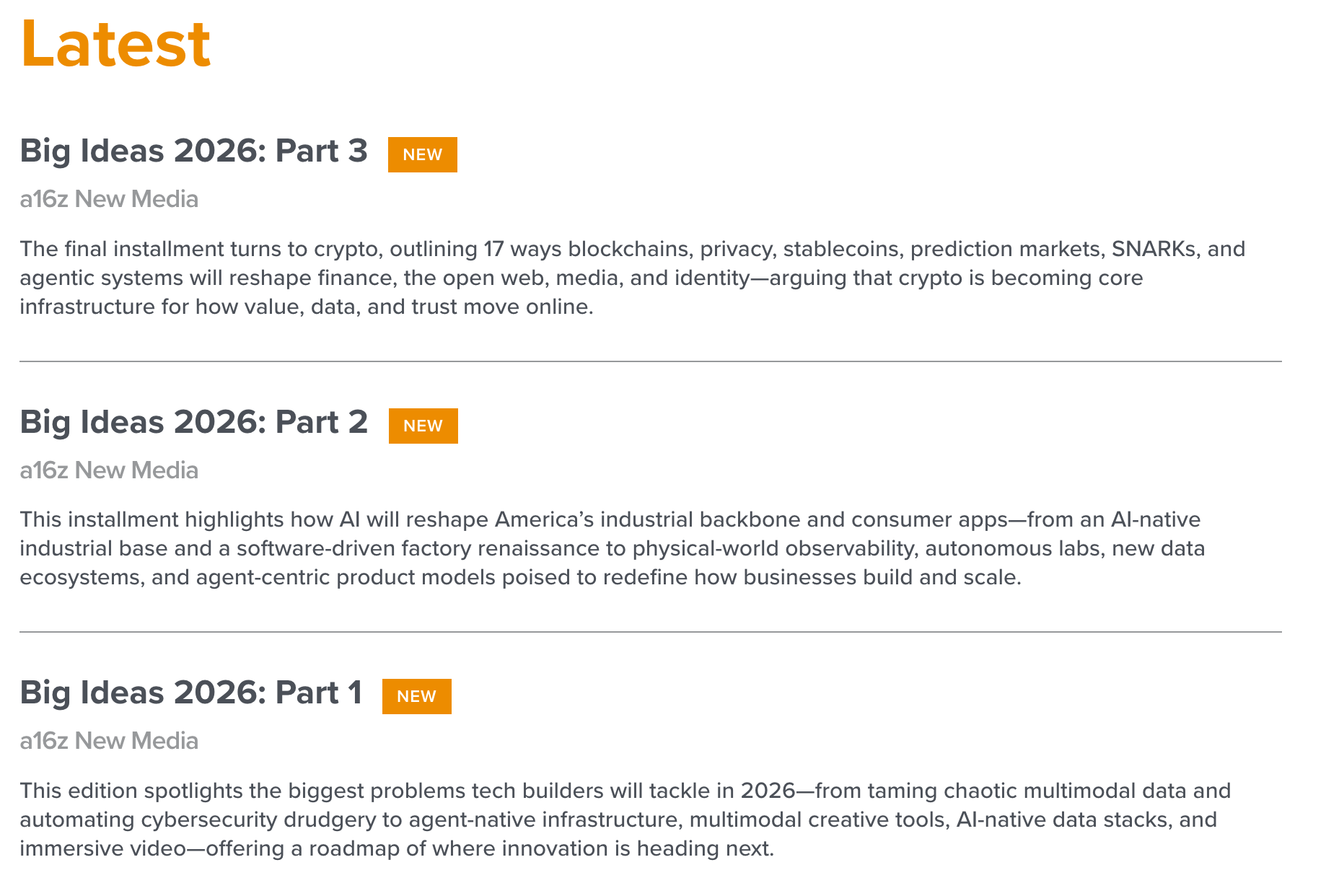
美国正以AI为核心重建工业基础,能源、制造、物流等领域涌现软件优先的创新企业,通过仿真设计、AI驱动运营构建未来产业。工厂复兴将福特式规模化与AI结合,实现核反应堆量产等突破;物理可观测性技术让基础设施实现实时监控;电气工业技术栈融合软硬件,重新定义自动化标准。金融业将转向AI原生系统,消费AI从工具型转向关系型。多智能体系统重构企业运营,2026年将成为AI企业规模化关键年,专注服务新兴公司的初
https://a16z.com/newsletter/big-ideas-2026-part-2/
Building the AI-native industrial base
David Ulevitch
America is rebuilding the parts of the economy that create real strength. Energy, manufacturing, logistics, and infrastructure are back in focus, and the most important shift is the rise of an industrial base that is truly AI native and software-first. These companies start with simulation, automated design, and AI-driven operations. They are not modernizing the past. They are building what comes next.
This is opening major opportunities in advanced energy systems, robotics heavy manufacturing, next-generation mining, biological and enzymatic processes that produce the precursor chemicals every industry depends on, and much more. AI can design cleaner reactors, optimize extraction, engineer better enzymes, and coordinate fleets of autonomous machines with a level of insight no legacy operator can match.
The same shift is reshaping the world outside the factory. Autonomous sensors, drones, and modern AI models can now give continuous visibility into ports, rail, power lines, pipelines, military bases, datacenters, and other critical systems that were once too large to manage comprehensively.
The real world needs new software. The founders who build it will shape the next century of American prosperity. If that’s you, let’s talk.
美国正在重建经济中创造真正实力的部分。能源、制造业、物流和基础设施重新成为焦点,最重要的转变是真正以人工智能为本、软件优先的工业基地正在崛起。这些企业从仿真模拟、自动化设计和AI驱动运营起步,并非对过去进行现代化改造,而是在构建未来。
这一变革正在开启诸多重大机遇:先进能源系统、机器人重型制造、下一代采矿技术、为所有行业提供关键前体化学品的生物酶催化工艺等。人工智能能设计更清洁的反应堆、优化资源开采、改造更高效的酶制剂,并以传统运营商无法企及的洞察力协调自主设备集群。
同样的变革正在重塑工厂外的世界。自主传感器、无人机和现代AI模型如今能持续监测港口、铁路、输电线、管道、军事基地、数据中心等以往因规模过大而难以全面管控的关键系统。
现实世界需要新软件。构建这些系统的创业者将塑造美国下一个百年的繁荣图景。若你正是这样的人,我们不妨详谈。
The renaissance of the American factory
Erin Price-Wright
America’s First Great Century was built on industrial strength, but it’s no secret that we’ve lost much of that muscle—some of it due to offshoring, some of it due to an intentional, society-wide failure to build. But the rusty wheels are starting to creak into motion again, and we’re witnessing the rebirth of the American factory with software and AI at its heart.
In 2026, I think we’ll see companies approach challenges spanning energy, mining, construction, and manufacturing with a factory mindset. This looks like the modular deployment of AI and autonomy alongside skilled workers to make complex, bespoke processes operate like an assembly line. Think:
- Quickly and repeatedly navigate complex regulation and permitting
- Speed up design cycles, and design-for-manufacture from the get-go
- Better manage large-scale project coordination
- Deploy autonomy to speed up tasks that are difficult or dangerous for humans to manage
By applying techniques that Henry Ford developed a century ago, planning for scale and repeatability on day 0, and layering in the latest advances in AI, we’ll soon be mass-producing nuclear reactors, building housing that meets our nation’s demand, constructing datacenters at breakneck speed, and entering a new Golden Age of industrial strength. To quote Elon Musk, “the factory is the product.”
美国的第一个伟大世纪建立在工业实力之上,但众所周知我们已丧失了大量这种实力——部分源于产业外迁,部分源于全社会在建设意愿上的集体缺失。但生锈的齿轮正开始吱呀转动,我们正见证以软件和人工智能为核心的美国工厂重生。
到2026年,我认为企业将以工厂思维应对能源、采矿、建筑和制造等领域的挑战。这意味着将AI和自动化技术模块化部署,与熟练工人协作,使复杂的定制流程像流水线般运作。具体表现为:
• 快速反复攻克复杂法规与审批流程
• 加速设计周期,从初始阶段就贯彻可制造性设计
• 更高效管理大型项目协同
• 运用自动化处理人类难以完成的危险复杂任务
通过运用亨利·福特百年前开创的规模化生产理念,在项目启动时就规划可复制性,再融合AI领域的最新突破,我们将很快实现核反应堆量产、按需建造住房、极速部署数据中心,迎来工业实力的新黄金时代。正如埃隆·马斯克所言:"工厂本身才是终极产品。"
The next wave of observability will be physical, not digital
Zabie Elmgren
Over the past decade, software observability transformed how we monitor digital systems, making codebases and servers transparent through logs, metrics, and traces. The same revolution is coming to the physical world.
With more than a billion networked cameras and sensors already deployed across U.S. cities, physical observability—understanding what’s happening in cities, power grids, and other infrastructure in real time—is becoming both urgent and possible. This new layer of perception will also enable the next frontier of robotics and autonomy, where machines depend on a common fabric that renders the physical world as observable as code.
Of course, this shift carries genuine risks: the same tools that can detect wildfires or prevent jobsite accidents could also enable dystopian nightmares. The winners in this next wave will be those who also earn public trust, building privacy-preserving, interoperable, AI-native systems that make society more legible without making it less free. Whoever builds that trusted fabric will define the next decade of observability.
过去十年间,软件可观测性通过日志、指标和追踪技术重构了数字系统监控方式,使代码库与服务器运行状态透明可见。同样的变革正在实体世界兴起。
随着超10亿台联网摄像头和传感器遍布美国城市,物理可观测性——实时掌握城市、电网及其他基础设施动态——既变得迫在眉睫又成为可能。这层新型感知网络还将为机器人技术与自主系统开辟新边疆,让机器依赖统一框架实现实体世界如代码般可观测。
当然,这种转变伴随真实风险:既能侦测山火预防工地事故的工具,也可能催生反乌托邦噩梦。下一轮浪潮的赢家将是那些同时赢得公众信任的构建者,他们打造的隐私保护、互联互通、AI原生系统能让社会更清晰可读而不减损自由。谁建立起这套可信框架,谁就将定义未来十年的可观测性格局。
The electro-industrial stack will move the world
Ryan McEntush
The next industrial revolution won’t just happen in factories, but inside the machines that power them.
Software transformed how we think, design, and communicate. Now it’s transforming how we move, build, and produce. Advances in electrification, materials, and AI are converging, bringing true software control to the physical world. Machines are beginning to sense, learn, and act on their own.
This is the rise of the electro-industrial stack—the combined technologies that power electric vehicles, drones, data centers, and modern manufacturing. It connects the atoms that move the world to the bits that command it: minerals refined into components, energy stored in batteries, electricity directed by power electronics, motion delivered through precision motors, all coordinated by software. It’s the invisible foundation behind every breakthrough in physical automation; it’s the difference between software that merely summons a taxi and software that takes the wheel.
But the capacity to build this stack, from refining critical materials to fabricating advanced chips, is slipping away. If the United States wants to lead the next industrial era, it must make the hardware that underpins it. The nations that master the electro-industrial stack will define the future of industrial and military technologies.
「https://substack.com/redirect/562328b7-b6f7-47ae-a564-27d89d60256d」
Software ate the world. Now it will move it.
下一次工业革命不仅会发生在工厂里,更将发生在驱动工厂运转的机器内部。
软件改变了我们的思维、设计和沟通方式。如今它正在改变我们的出行、建造和生产模式。电气化、材料和人工智能的进步正相互融合,将真正的软件控制带入物理世界。机器开始具备感知、学习和自主行动的能力。
这就是电气工业技术栈的崛起——这些组合技术驱动着电动汽车、无人机、数据中心和现代制造业。它连接了推动世界的原子与指挥世界的比特:矿物提炼成组件,能量储存在电池中,电力由功率电子器件调控,运动通过精密电机传递,所有环节由软件协调。这是每个实体自动化突破背后的无形基石;是仅能召唤出租车与能真正掌控方向盘的软件之间的本质区别。
但从关键材料提炼到先进芯片制造的整个技术栈构建能力正在流失。如果美国想引领下一个工业时代,就必须制造支撑这一切的硬件。掌握电气工业技术栈的国家,将定义未来工业和军事技术的走向。
软件吞噬了世界。现在它将驱动世界。
Autonomous labs accelerate scientific discovery
Oliver Hsu
As model capabilities progress across modalities and robotic manipulation capabilities continue to improve, teams will accelerate their pursuit of autonomous scientific discovery. These parallel technologies will enable autonomous labs that can close the loop on scientific discovery — from hypothesis development to experiment design and execution and through reasoning, results, and iterating on future research directions. The teams that build these labs will be interdisciplinary in nature and will unify expertise across AI, robotics, the physical and life sciences, manufacturing, operations, and more to unlock continuous experimentation via lights-out labs for discovery across fields.
随着模型能力在多模态领域的进步以及机器人操作能力的持续提升,研究团队将加速实现自主科学发现。这些并行技术将推动自主实验室实现科学发现的闭环流程——从假设构建、实验设计与执行,到结果推理及未来研究方向迭代。建设这类实验室的团队将具备跨学科特质,整合人工智能、机器人技术、物理与生命科学、制造运营等领域的专业知识,通过无人值守实验室实现跨学科持续探索。
Data crusade in our critical industries
Will Bitsky
In 2025, the AI zeitgeist was defined by compute constraints and data center buildout. In 2026, it will be defined by data constraints and the next frontier in the crusade for data: our critical industries.
Our critical industries remain wellsprings of latent, unstructured data. Each truck roll, meter read, maintenance job, production run, assembly, and test fire is fodder for model training. But neither capture, nor annotation, nor model training are part of the industrial lexicon.
There’s no lack of demand for this data. Companies like Scale, Mercor, and AI research labs are insatiably collecting process data (not just “what” is done, but “how”). And they pay a steep price to commission each unit of sweatshop data.
Industrial companies with existing physical infrastructure and labor forces have a comparative advantage in data collection and will begin to exploit it. Their operations generate immeasurable amounts of data that can be captured with near-zero marginal cost, and used to train owned models or licensed to third parties.
And we should expect startups will show up to help. Startups will deliver the coordination stack: software tools for collection, annotation, and consent; sensor hardware and SDKs; RL environments and training pipelines; and eventually, their own intelligent machines.
2025年的人工智能时代精神由算力限制和数据中心建设定义。到了2026年,决定性因素将转变为数据约束,以及这场数据圣战的新战场:我们的关键产业。
关键产业仍是潜在非结构化数据的源泉。每次卡车运输、仪表读数、维修作业、生产运行、装配组装和点火测试,都是模型训练的素材。但数据采集、标注和模型训练这些概念尚未进入工业术语体系。
这类数据的需求量极为旺盛。Scale、Mercor等公司及AI研究实验室正贪婪地收集流程数据(不仅记录"做什么",更关注"怎么做")。他们为每份血汗工厂式数据都支付着高昂代价。
拥有实体基础设施和劳动力的工业企业在数据收集方面具有比较优势,并将开始加以利用。其运营产生的海量数据能以近乎零边际成本被捕获,既可用于训练自有模型,也可授权给第三方使用。
我们还将看到初创企业的助力。它们将提供协同技术栈:用于采集、标注和授权的软件工具;传感器硬件与开发套件;强化学习环境与训练管道;最终还会推出自己的智能机器。
AI reinforces business models
David Haber
The best AI startups aren’t just automating tasks; they’re amplifying the economics of their customers. In contingency-based law, for example, firms only make money when they win. Companies like Eve use proprietary outcomes data to predict case success, helping firms pick better cases, serve more clients, and win more often.
AI strengthens the business model itself. It drives more revenue, not just lower costs. In 2026, we’ll see this logic extend across industries, as AI systems deepen alignment with their customers’ incentives and create compounding advantages legacy software can’t touch.
最优秀的AI初创企业不仅实现了任务自动化,更放大了客户的经济效益。以风险代理法律行业为例,律所唯有胜诉才能获得收益。像Eve这样的公司运用专有案件结果数据进行胜诉预测,帮助律所筛选优质案件、服务更多客户并提高胜诉率。
AI强化了商业模式本身。它带来的不仅是成本降低,更是收入增长。到2026年,随着AI系统与客户激励机制深度契合并创造传统软件无法企及的复合优势,我们将看到这一逻辑在各行业全面铺开。
ChatGPT becomes the AI app store
Anish Acharya
Consumer product cycles require three things to work: new technology, new consumer behavior, and a new distribution channel.
Until recently, the AI wave had fulfilled the first two conditions but had no new native distribution channel. Most products grew off the back of existing networks like X or by word of mouth.
With the recent release of the OpenAI Apps SDK, Apple’s support for mini-apps, and ChatGPT’s roll out of group messaging, though, consumer developers can now tap ChatGPT’s 900M user audience directly and also grow with new networks of mini-apps like Wabi. As the final piece in the consumer product cycle, this new distribution channel is set to kick off a once-in-a-decade gold rush in consumer tech in 2026. Ignore at your own peril.
消费品周期需要三个要素才能运转:新技术、新消费行为和新分销渠道。
直到最近,人工智能浪潮已满足前两个条件,但缺乏原生分销渠道。大多数产品依托现有网络(如X平台)或口碑传播实现增长。
然而随着OpenAI应用SDK的发布、苹果对小程序的兼容支持,以及ChatGPT群聊功能的推出,开发者现在能直接触达ChatGPT的9亿用户,还能通过Wabi等新型小程序网络实现增长。作为消费品周期的最后拼图,这个新分销渠道将引爆2026年消费科技领域十年一遇的淘金热。忽视它,后果自负。
Voice agents take up space
Olivia Moore
In the last 18 months, the idea of AI voice agents managing real interactions for businesses has gone from science fiction to reality. Thousands of companies, from SMBs to enterprises, are using voice AI to schedule appointments, complete bookings, run surveys, do intakes, and much more. These agents save costs for businesses, generate additional revenue, and free up human employees to do higher leverage—and more enjoyable—tasks.
But because the space is so nascent, many companies are still in the “voice-as-a-wedge” phase, offering one or several types of calls as a point solution. I’m excited to see voice agents expand into handling entire workflows (which might be multi-modal) and even into managing full customer relationship cycles.
This will likely involve agents that are more deeply integrated into business systems and given the freedom to manage more complex types of interactions. As the underlying models continue to improve—and agents can now call tools and operate across systems—there’s no reason why every company shouldn’t have voice-first AI products running and optimizing critical parts of their business.
在过去18个月里,AI语音助手为企业管理真实互动的设想已从科幻变为现实。从中小企业到大型企业,数千家公司正在使用语音AI来安排预约、完成预订、开展调研、处理接待等各类事务。这些智能助手既为企业节省成本、创造额外收入,又能解放人力去处理更具杠杆效应且更有趣的工作。
但由于该领域尚处萌芽期,许多公司仍停留在"语音切入"阶段,仅提供单一或少数几种通话服务作为解决方案。令我振奋的是,语音助手正逐步拓展至处理完整工作流(可能是多模态的),甚至管理完整的客户关系周期。
这需要将智能助手更深度整合到企业系统中,并赋予其管理更复杂交互类型的自由度。随着底层模型持续优化——如今智能助手已能调用工具实现跨系统操作——每家企业都理应部署语音优先的AI产品,用以运行和优化其核心业务环节。
Prompt-free and proactive applications arrive
Marc Andrusko
2026 marks the death of the prompt box for mainstream users. The next wave of AI apps will have zero visible prompting—they’ll observe what you’re doing and intervene proactively with actions for you to review. Your IDE suggests the refactor before you ask. Your CRM drafts the follow-up email when you finish a call. Your design tool generates variations as you work. The chat interface was training wheels. Now AI becomes invisible scaffolding woven through every workflow, activated by intent rather than instruction.
2026年标志着提示框对主流用户的消亡。新一代人工智能应用将完全消除可见的指令输入——它们会观察你的行为,主动介入并提供待审核的操作建议。集成开发环境在你开口前就推荐代码重构方案;客户关系管理系统在你结束通话时自动草拟跟进邮件;设计工具在你工作时实时生成多种设计变体。聊天界面只是过渡阶段的辅助轮。如今,人工智能将化作无形支架融入每个工作流程,由用户意图而非明确指令触发运作。
AI will finally upgrade banking and insurance infrastructure
Angela Strange
Plenty of banks and insurance companies have integrated AI like document ingestion and AI voice agents on top of their legacy systems, but AI won’t truly transform financial services until we rebuild the infrastructure that powers it.
In 2026, the risk of not modernizing to take full advantage of AI will outweigh the risk of failure, and we’ll see large financial institutions let their legacy vendor contracts lapse and start implementing newer, AI-native alternatives. Unencumbered by the category seams of the past, these companies are platforms that centralize, normalize, and enrich underlying data from legacy systems and external sources.
The result?
- Workflows can be dramatically streamlined and parallelized. No more hopping between systems and screens. Think: you can see and parallelize all of the hundreds of tasks that need to be completed in your mortgage LOS, and agents can even complete the more mundane ones.
- Categories as we know them will merge to create much bigger categories. Customer KYC from onboarding and transition monitoring data, for instance, could now sit together in a single risk platform.
- The new winners of these categories will be 10x the size of the older incumbents: the categories are much bigger, and the software market is eating labor.
The future of financial services isn’t about applying AI to old systems; it’s about building a new operating system where AI is the foundation.
「https://substack.com/redirect/e6a1f376-cb87-4bc3-8bf4-c8b741139656」
许多银行和保险公司已在原有系统基础上整合了文件录入、AI语音助手等人工智能技术,但只有当我们重构支撑金融服务的底层基础设施时,AI才能真正改变这个行业。
到2026年,拒绝现代化改造以充分利用AI的风险将超过转型失败的风险。届时大型金融机构将任由传统供应商合同到期失效,转而采用新型的AI原生替代方案。这些不受历史业务条块分割束缚的新平台,能够集中整合、规范处理并深度挖掘传统系统与外部数据的核心价值。
这将带来什么改变?
— 工作流程可以得到显著简化和并行化。无需再在不同系统和屏幕间来回切换。想象一下:你能够查看并并行处理抵押贷款业务系统中需要完成的数百项任务,甚至可以让代理人完成那些更琐碎的工作。
— 现有的分类将会融合形成更大的类别。例如,客户开户时的KYC(了解你的客户)数据和交易监控数据现在可以整合到同一个风险平台中。
— 这些新领域的赢家规模将是老牌企业的十倍:因为分类范畴变得更大,而且软件市场正在吞噬劳动力市场。
金融服务的未来不在于给旧系统打AI补丁,而在于构建以AI为基石的全新操作系统。
Forward-deployed motions take AI to the 99%
Joe Schmidt
AI is the most exciting technology breakthrough of our lifetimes. So far, though, most of the benefits from new startups have accrued to the 1% of companies that are in Silicon Valley—either literally in the Bay Area or part of that extended network. This makes sense, too: startup founders want to sell to companies they recognize and can easily get to, whether that means driving to their offices or getting a connection from the VC on their board.
In 2026, this will flip. Companies will realize that the vast majority of the AI opportunity lives outside of Silicon Valley, and we’re going to see new founders use forward-deployed motions to discover more opportunities that are hiding inside big, legacy verticals. The opportunity stands to be massive in traditional consulting and services industries, like system integrators and implementation firms, and in slower-moving industries like manufacturing.
人工智能是我们这个时代最令人振奋的技术突破。然而迄今为止,大多数新兴初创企业带来的红利都流向了硅谷那1%的企业——无论是实际位于湾区还是属于其延伸网络中的一员。这也不难理解:初创企业创始人总希望将产品卖给熟悉且容易接触的公司,无论是开车就能抵达其办公室,还是通过董事会中的风投牵线搭桥。
到2026年,这种情况将彻底改变。企业将意识到人工智能领域的绝大部分机遇其实存在于硅谷之外,我们将看到新一代创业者采用前沿部署策略,在传统大型垂直行业中发现更多隐藏机会。这种机遇在传统咨询服务业(如系统集成商和实施公司)以及发展较慢的行业(如制造业)中将尤为显著。
AI creates a new orchestration layer—and new roles—in the Fortune 500
Seema Amble
In 2026, enterprises will shift further from isolated AI tools to multi-agent systems that will need to behave like coordinated digital teams. As agents start to manage complex, interdependent workflows—like planning, analyzing, and executing together—organizations will need to rethink how work is structured and how context flows across systems. We’re already seeing this happen with companies like AskLio and HappyRobot, which deploy agents across entire processes instead of single tasks.
The Fortune 500 will feel this shift most acutely: they sit on the deepest reservoirs of siloed data, institutional knowledge, and operational complexity, much of which sits in people’s brains. Turning that context into a shared substrate for autonomous workers will unlock faster decisions, compressed cycles, and end-to-end processes that no longer rely on constant human micromanagement.
This transition will also force leaders to reimagine roles and software. New functions will emerge, like AI workflow designers, agent supervisors, and governance leads responsible for orchestrating and auditing coordinated fleets of digital workers. And on top of today’s systems of record, enterprises will need systems of coordination: new layers to manage multi-agent interactions, adjudicate context, and ensure reliability across autonomous workflows. Humans will be focused on handling the edge and most complex cases. The rise of multi-agent systems isn’t just another step in automation; it represents a restructuring of how enterprises operate, how decisions are made, and ultimately where value is created.
到2026年,企业将从孤立的AI工具进一步转向需要像协调数字团队那样运作的多智能体系统。随着智能体开始管理相互依赖的复杂工作流(如协同规划、分析和执行),组织需要重新思考工作架构及上下文信息如何在系统间流转。AskLio和HappyRobot等公司已开始实践——它们在整个流程而非单一任务中部署智能体。
《财富》500强企业将最深刻感受到这种转变:它们拥有最庞大的数据孤岛、制度性知识和运营复杂性,其中大量知识仅存在于员工头脑中。将这些上下文转化为自主工作者的共享基础,将实现更快决策、压缩周期和不再依赖人类持续微观管理的端到端流程。
这一转型还将迫使领导者重新构想岗位与软件。新职能将应运而生,例如AI工作流设计师、智能体督导员,以及负责协调和审计数字员工团队的治理主管。在现有记录系统之上,企业需要建立协调系统——用于管理多智能体交互、裁定上下文信息并确保自主工作流可靠性的新层级。人类将专注于处理边缘及最复杂的情况。多智能体系统的崛起不仅是自动化的又一步,更代表着企业运营方式、决策机制乃至价值创造源头的结构性变革。
Consumer AI shifts from “help me” to “see me”
Bryan Kim
2026 marks the year major consumer AI products shift from productivity to connectivity. Instead of helping you do work, AI will allow you to see yourself more clearly and help you build stronger relationships.
To be clear: this is hard. Many social AI products have launched and failed. But thanks to multimodal context windows and falling inference costs, AI products can now learn from the full texture of your life, not just what you’ve told a chatbot. Think camera rolls that show real emotional moments, 1:1 messaging and group chat patterns that change depending on who you’re talking to, and routines that shift under stress.
Once these products do land, they’ll become part of our everyday lives. Generally, “see me” products have better inherent retention mechanics than “help me” products. “Help me” products monetize through high willingness-to-pay on discrete jobs and optimize for subscriber retention. “See me” products monetize through daily engagement on ongoing connection: lower willingness-to-pay but more retentive usage patterns.
People already trade data for value constantly: the question is whether what they get back is worth it. And it soon will be.
2026年将标志着主流消费级AI产品从生产力工具转向连接工具的转折点。届时AI不再只是协助工作,而是帮助你更清晰地认识自我,并建立更牢固的人际关系。
需要明确的是:这并非易事。许多社交型AI产品已经尝试过但失败了。但得益于多模态上下文窗口技术的出现和推理成本的下降,如今的AI产品能够从你生活的完整脉络中学习,而不仅限于你告诉聊天机器人的内容。比如相册里记录的真实情感瞬间,根据不同对话对象变化的私信和群聊模式,以及在压力下发生改变的日常习惯。
一旦这类产品真正落地,它们将成为我们日常生活的一部分。从本质上说,"懂我"型产品比"帮我"型产品具有更好的用户留存机制。"帮我"类产品通过用户对特定任务的高支付意愿实现盈利,并侧重维护订阅用户;而"懂我"类产品则通过持续连接中的日常互动获利——虽然单次支付意愿较低,但用户使用黏性更强。
人们早已习惯用数据交换价值:关键在于获得的回报是否值得。而很快,这个等式就会成立。
New model primitives unlock previously impossible companies
Kimberly Tan
In 2026, we’ll see the emergence of companies that simply could not have existed before recent model breakthroughs in reasoning, multimodality, and computer use. Until now, many sectors (such as legal or customer support) have used improved reasoning to enhance existing products. But we’re only now beginning to see companies whose core product capabilities are fundamentally enabled by these new model primitives.
Advances in reasoning could unlock new capabilities to evaluate complex financial claims or act upon dense academic or analyst research (e.g., adjudicating billing disputes). Multimodal models make it possible to extract latent video data for industries rooted in the physical world (e.g., from cameras at manufacturing sites). And computer use enables automation in massive industries where value was historically trapped behind desktop software, poor APIs, and fragmented workflows.
2026年,我们将见证一批因推理能力、多模态技术和计算机应用领域的最新突破而诞生的新兴企业。迄今为止,法律和客服等行业主要通过提升推理能力来优化现有产品。但现在我们正首次看到,某些企业的核心产品功能完全依托于这些新型基础模型能力而存在。
推理技术的进步将催生评估复杂金融索赔、处理深奥学术研究报告的新能力(例如裁决账单纠纷)。多模态模型可挖掘实体产业中潜藏的视觉数据价值(如从制造现场的监控视频提取信息)。而计算机应用自动化将释放那些长期受限于桌面软件、低效接口和碎片化工作流程的传统行业的巨大价值。
AI startups selling to other AI startups reach scale
James da Costa
We’re in an unprecedented moment of company creation driven by the current AI product cycle. But unlike previous product cycles, incumbents aren’t asleep at the wheel; they’re adopting AI too. So how does the startup win?
One of the most powerful, and underrated, ways for startups to win distribution over incumbents is to serve companies at their formation: greenfield companies (i.e., brand new businesses). If you attract all of the new companies at formation and grow with them, you will become a big company as your customers become big companies. Stripe, Deel, Mercury, Ramp, and others have all followed this playbook. Indeed, many of Stripe’s customers didn’t exist when Stripe was founded.
2026 will be the year that we see the startups going greenfield reach scale across a host of enterprise software categories. Just build a better product and manically focus on new customers who aren’t captive to incumbents.
当前AI产品周期推动下,企业创建正迎来前所未有的浪潮。但与以往产品周期不同,行业巨头并未袖手旁观,他们也在积极拥抱AI技术。那么初创企业如何突围制胜?
最有效却被低估的策略是:在客户企业初创阶段就锁定服务——即瞄准全新成立的绿地公司。若能吸引所有新创企业并伴随其成长,当这些客户发展为巨头时,你自然将成为行业巨头。Stripe、Deel、Mercury、Ramp等企业都成功实践了这一策略。事实上,Stripe创立时其多数客户尚未诞生。
2026年将成为见证初创企业通过绿地战略在多领域实现规模化的关键年份。只需打造更优质的产品,并疯狂聚焦那些尚未被巨头绑定的新客户。
https://a16z.com/newsletter/big-ideas-2026-part-1/
https://a16z.com/newsletter/big-ideas-2026-part-2/
https://a16z.com/newsletter/big-ideas-2026-part-3/

火山引擎开发者社区是火山引擎打造的AI技术生态平台,聚焦Agent与大模型开发,提供豆包系列模型(图像/视频/视觉)、智能分析与会话工具,并配套评测集、动手实验室及行业案例库。社区通过技术沙龙、挑战赛等活动促进开发者成长,新用户可领50万Tokens权益,助力构建智能应用。
更多推荐
 28
28 0
0- 0


 已为社区贡献20条内容

所有评论(0)