啸叫抑制(AFS)从算法仿真到工程源码实现-第六节-陷波法
一、概述
根据啸叫频点检测算法,计算每个频点的特征【峰值阈值功率比(Peak-to-Threshold Power Raio, PTPR),峰值均值功率比(Peak-to-Average Power Raio, PAPR)、峰值邻近功率比(Peak-to-Neighboring Power Raio, PNPR)、峰值谐波功率比(Peak-to-Harmonics Power Raio, PHPR)、帧间峰值保持度(Interframe Peak Magnitude Persistence, IPMP)、帧间幅度斜率偏差度(Interframe Magnitude Slope Deviation, IMSD)】,找到啸叫频点,并对相应的频点幅值进行抑制。主要有几个问题:(1)啸叫频点的数量是个问题,这个不好把握,过多对语音损伤比较严重,极限情况下语音全部被抑制掉,过少又漏掉一些啸叫点,一些系统设计为3个固定的频点加上3个自适应的频点。(2)啸叫频点检测的正确性问题,有误检和漏检的情况。(3)实时性也是个问题,我们输入处理一帧是160个点,但是FFT必须是128个点,这样就需要拼帧,拼帧会带来延迟的问题,我们的解决方案是在频域检测频点,在时域处理,这样可以解决实时性的问题。(4)频点的精度问题,我们处理频点的精度一般为8000/128=62.5Hz,这样可能检测到的频点和真实啸叫频点不一致。
二、算法仿真
2.1 算法流程图
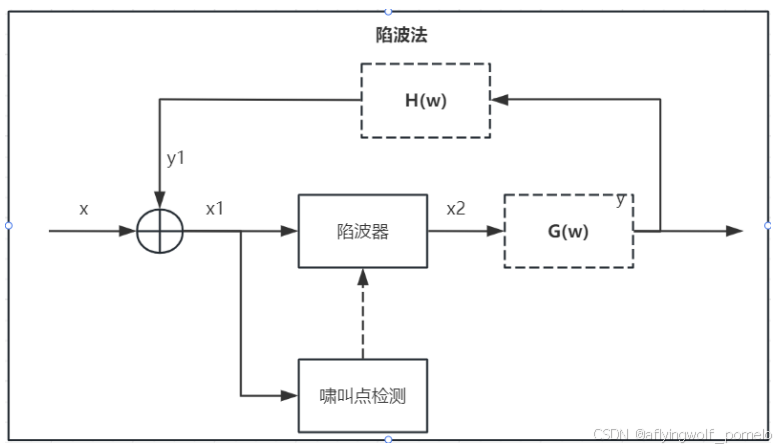
2.2 啸叫频点检测仿真
#!/usr/bin/python

"""
Functions for howling frequency detection.

"""
from __future__ import division

import numpy as np

def papr(frame, threshold):
    """Peak-to-Avarage Power Ratio (PAPR)
    Returns all frequency indices where power is greater than avarage power + threshold,
    which are possible candidates where howling occurs.

    Args:
        frame: Spectrum of one frame.
        threshold: Power threshold value in dB.
         The returned candidates should have power greater than average power + threshold.

    Returns:
        A list of selected frequncy indices.
        A list of PAPR value for every freqency bin of this frame.
    """
    power = np.abs(frame)**2
    papr = np.zeros(len(power))
    avarage = np.mean(power)
    ret = []
    for i in range(len(frame)):
        papr[i] = 10*np.log10(power[i]/avarage)
        if (papr[i] > threshold):
            ret.append(i)
    return ret, papr

def ptpr(frame, threshold):
    """Peak-to-Threshold Power Ratio (PTPR)
    Returns all frequency indices where power is greater than threshold,
    which are possible candidates where howling occurs.

    Args:
        frame: Spectrum of one frame.
        threshold: Power threshold value in dB.

    Returns:
        A list of selected frequncy indices.
    """
    power =  np.abs(frame)**2
    ret = []
    for i in range(len(frame)):
        if (10*np.log10(power[i]) > threshold):
            ret.append(i)
    return ret

#def phpr(frame, threshold):
"""Peak-to-Harmonic Power Ratio (PHPR)
       To-Do
    Args:

    Returns:

"""

def pnpr(frame, threshold):
    """Peak-to-Neighboring Power Ratio (PNPR)
    Returns all frequency indices of power peaks,
    which are greater than neighboring frequency bins by a threshold.

    Args:
        frame: Spectrum of one frame.
        threshold: Power threshold value in dB.

    Returns:
        A list of selected frequncy indices.
    """
    power =  frame**2
    ret = []
    for i in range(5, len(frame)-5):
        if (10*np.log10(power[i]/power[i-4]) > threshold
        and 10*np.log10(power[i]/power[i-5]) > threshold
        and 10*np.log10(power[i]/power[i+4]) > threshold
        and 10*np.log10(power[i]/power[i+5]) > threshold ):
            ret.append(i)
    return ret

def ipmp(candidates, index):
    """Inerframe Peak Magnitude Persistence (IPMP)
    Temporal howling detection criteria. Candidate should meet criteria
    in more than 3 frames out of 5 continuous frames.

    Args:
        candidates: nFreqs X nFrames
                    candidates[f][t] = 1 means a candidate at frequency[f]  at frame[t]
        index: Current frame index.

    Returns:
        A list of selected frequncy indices.
    """
    accu = np.zeros(candidates.shape[0])

    if(index == 2):
        accu = np.sum(candidates[:, :index+1], axis=1)
    elif (index == 3):
        accu = np.sum(candidates[:, :index+1], axis=1)
    else:
        accu = np.sum(candidates[:, index-4:index+1], axis=1)

    #ipmp = np.squeeze(np.argwhere(accu >=3))
    ipmp = [idx for idx, val in enumerate(accu) if val >= 3]
    return ipmp


#def imsd(frame, threshold):

def screening(frame, candidates):
    """
    Screen the candidates. Only one frequency in neighboring several frequencies is needed

    Args:
        frame: Current frame spectrum.
        candidates: nFreqs X nFrames
                    candidates[f][t] = 1 means a candidate at frequency[f]  at frame[t]

    Returns:
        A list of selected frequncy indices.
    """
    ret = []
    for c in candidates:
        if len(ret)==0:
            ret.append(c)
        elif ret[len(ret)-1] > c-3 :
            if abs(frame[ret[len(ret)-1]]) < abs(frame[c]):
                ret[len(ret)-1] = c
        else:
            ret.append(c)
    return ret
2.3 啸叫抑制仿真
#!/usr/bin/python
from __future__ import division
# import

import numpy as np
from scipy import signal
import matplotlib.pyplot as plt
import soundfile as sf
import pyHowling


def howling_detect(frame, win, nFFT, Slen, candidates, frame_id):
    insign = win * frame
    spec = np.fft.fft(insign, nFFT, axis=0)

    #==========  Howling Detection Stage =====================#
    ptpr_idx = pyHowling.ptpr(spec[:Slen], 10)
    papr_idx, papr = pyHowling.papr(spec[:Slen], 10)
    pnpr_idx = pyHowling.pnpr(spec[:Slen], 15)
    intersec_idx = np.intersect1d(ptpr_idx, np.intersect1d(papr_idx,pnpr_idx))
    #print("papr:",papr_idx)
    #print("pnpr:",pnpr_idx)
    #print("intersection:", intersec_idx)
    for idx in intersec_idx:
        candidates[idx][frame_id] = 1
    ipmp = pyHowling.ipmp(candidates, frame_id)
    #print("ipmp:",ipmp)
    result = pyHowling.screening(spec, ipmp)
    #print("result:", result)
    return result

def main():
    input_file = "test/LDC93S6A.wav"
    howling_file = "test/added_howling.wav"
    output_file = "test/removed_howling.wav"

    #load clean speech file
    x, Srate = sf.read(input_file)

    #pre design a room impulse response
    rir = np.loadtxt('test/path.txt', delimiter='\t')
    plt.figure()
    plt.plot(rir)

    #G : gain from mic to speaker
    G = 0.2

     # ====== set STFT parameters ========
    interval = 0.01 #frame interval = 0.02s
    Slen = int(np.floor(interval * Srate))
    if Slen % 2 == 1:
        Slen = Slen + 1
    PERC = 50  #window overlap in percent of frame size
    len1 = int(np.floor(Slen * PERC / 100))
    len2 = int(Slen - len1)
    nFFT = 2 * Slen
    freqs = np.linspace(0, Srate, nFFT)
    Nframes = int(np.floor(len(x) / len2) - np.floor(Slen / len2))

    #Hanning window for stft
    win = np.hanning(Slen)
    win = win * len2 / np.sum(win)

    plt.figure()
    plt.subplot(2,1,1)
    plt.plot(x)
    plt.xlim(0, len(x))
    plt.subplot(2,1,2)
    plt.specgram(x, NFFT=nFFT, Fs=Srate, noverlap=len2, cmap='jet')
    plt.ylim((0, 5000))
    plt.ylabel("Frquency (Hz)")
    plt.xlabel("Time (s)")

    #simulate acoustic feekback, point-by-point
    #                                    _______________                              _______________
    #   clean speech: x --> mic: x1 --> | Internal Gain | --> x2 -- > speaker : y--> | Room Impulse  |
    #                        ^          |______G________|                            |____Response___|
    #                        |                                                              |
    #                         ----------------------<-----y1--------------------------------V
    #
    N = min(2000, len(rir)) #limit room impulse response length
    x2 = np.zeros(N)   #buffer N samples of speaker output to generate acoustic feedback
    y = np.zeros(len(x))  #save speaker output to y
    y1 = 0.0           #init as 0
    for i in range(len(x)):
        x1 = x[i] + y1
        y[i] = G*x1
        y[i] = min(2, y[i])   #amplitude clipping
        y[i] = max(-2, y[i])
        x2[1:] = x2[:N-1]
        x2[0] = y[i]
        y1 = np.dot(x2, rir[:N])


    sf.write(howling_file, y, Srate)
    plt.figure()
    plt.subplot(2,1,1)
    plt.plot(y)
    plt.xlim((0, len(y)))
    plt.subplot(2,1,2)
    plt.specgram(y, NFFT=nFFT, Fs=Srate, noverlap=len2, cmap='jet')
    plt.ylim((0, 5000))
    plt.ylabel("Frquency (Hz)")
    plt.xlabel("Time (s)")


    #=============================Notch Filtering =======================================================
    #                                       ___________________
    #                             -------> | Howling Detection | ______
    #                            |         |___________________|       |
    #                            |                                     |
    #                            |      _______________         _______V______
    #   clean speech: x --> mic: x1 --> | Internal Gain |-x2--> | Notch Filter | --> speaker : y
    #                        ^          |______G________|       |_____IIR______|         |
    #                        |                                                           |
    #                        |                      _______________                      |
    #                        <-----------------y1--| Room Impulse  |____________________ v
    #                                              |____Response___|
    #
    b = [1.0, 0 ,0]
    a = [0, 0, 0]
    N = min(2000, len(rir)) #limit room impulse response length
    x2 = np.zeros(100)   #
    x3 = np.zeros(N)   #buffer N samples of speaker output to generate acoustic feedback
    y = np.zeros(len(x))  #save speaker output to y
    y1 = 0.0           #init as 0
    current_frame = np.zeros(Slen)
    pos = 0
    candidates = np.zeros([Slen, Nframes+1], dtype='int')
    frame_id = 0
    notch_freqs = []

    for i in range(len(x)):
        x1 = x[i] + y1
        current_frame[pos] = x1
        pos = pos + 1
        if pos==Slen:
            #update notch filter frame by frame
            freq_ids = howling_detect(current_frame, win, nFFT, Slen, candidates, frame_id)
            #freq_ids = [46]
            if(len(freq_ids)>0 and (len(freq_ids)!=len(notch_freqs) or not np.all(np.equal(notch_freqs, freqs[freq_ids])))):
                notch_freqs = freqs[freq_ids]
                sos = np.zeros([len(notch_freqs), 6])
                for i in range(len(notch_freqs)):
                    b0, a0 = signal.iirnotch(notch_freqs[i], 1, Srate)
                    sos[i,:] = np.append(b0,a0)
                b, a = signal.sos2tf(sos)
            print("frame id: ", frame_id, "/", Nframes, "notch freqs:", notch_freqs)
            current_frame[:Slen-len2] = current_frame[len2:]  #shift by len2
            pos = len2
            frame_id = frame_id + 1

        x2[1:] = x2[:len(x2)-1]
        x2[0] = G*x1
        x2[0] = min(2, x2[0])  #amplitude clipping
        x2[0] = max(-2, x2[0])
        y[i] = np.dot(x2[:len(b)], b) - np.dot(x3[:len(a)-1], a[1:])  #IIR filter
        y[i] = min(2, y[i])  #amplitude clipping
        y[i] = max(-2, y[i])
        x3[1:] = x3[:N-1]
        x3[0] =  y[i]
        y1 = np.dot(x3, rir[:N])

    pyHowling.plot_notch_filter(b, a, Srate)
    xfinal = y
    sf.write(output_file, xfinal, Srate)

    plt.figure()
    plt.subplot(2,1,1)
    plt.plot(xfinal)
    plt.xlim((0, len(xfinal)))
    plt.subplot(2,1,2)
    plt.specgram(xfinal, NFFT=nFFT, Fs=Srate, noverlap=len2, cmap='jet')
    plt.ylim((0, 5000))
    plt.ylabel("Frquency (Hz)")
    plt.xlabel("Time (s)")
    plt.show()


main()
2.4 啸叫频点检测工程化
/*
 * @author : aflyingwolf
 * @date   : 2025.3.24
 * @file   : afs-function.h
*/

#include <math.h>

void afs_evaluate_PTPR(const float *Y, float *PTPR, int len) {
  for (short i = 0; i < len; ++i) {
    PTPR[i] = 10 * log10f(Y[i] * Y[i]);
  }
}

void afs_evaluate_PAPR(const float *Y, float *PAPR, int len) {
  float energy = 0;
  for (short i = 0; i < len; ++i) {
    energy += Y[i] * Y[i];
  }
  energy /= len;
  for (short i = 0; i < len; ++i) {
    PAPR[i] = 10 * log10f(Y[i] * Y[i] / energy);
  }
}
void afs_evaluate_PNPR(const float *Y, float *PNPR, int len) {
  static const int m[10] = {1, -1, 2, -2, 3, -3, 4, -4, 5, -5};
  for (short i = 0; i < len; ++i) {
    PNPR[i] = 0;
    int k = 0;
    for (short j = 0, i2; j < 10; ++j) {
      i2 = i + m[j];
      if (i2 < len && i2 > 0) {
        k++;
        PNPR[i] += 10 * log10f(Y[i] * Y[i] / Y[i2] / Y[i2]);
      }
    }
    PNPR[i] /= k;
  }
}
void afs_evaluate_PHPR(const float *Y, float *PHPR, int len) {
  for (short i = 0, i2; i < len; ++i) {
    PHPR[i] = 100;
    i2 = 2 * i; // m = 2
    if (i2 < len) {
      PHPR[i] = 10 * log10f(Y[i] * Y[i] / Y[i2] / Y[i2]);
    }
    i2 = 3 * i; // m = 3
    if (i2 < len) {
      float phprc = 10 * log10f(Y[i] * Y[i] / Y[i2] / Y[i2]);
      if (phprc < PHPR[i]) {
        PHPR[i] = phprc;
      }
    }
  }
}

void afs_evaluate_IMSD(const float *Y_buf, float *IMSD, int len, int num) {
  const short Q_m = num - 1,
              P   = 1,
              t   = num - 1;
  float fst_sum, snd_sum;
  for (short i = 0; i < len; ++i) {
    IMSD[i] = 0;
    fst_sum = 0;
    for (short j = 0; j < Q_m; ++j) {
      fst_sum += 20 * (log10f(Y_buf[(t - j*P) * len + i])
                 - log10f(Y_buf[(t - Q_m*P) * len + i])) / (Q_m - j);
    }
    for (short m = 1; m < Q_m; ++m) {
      snd_sum = 0;
      for (short j = 0; j < m; ++j) {
        snd_sum += 20 * (log10f(Y_buf[(t - j*P) * len + i])
                   - log10f(Y_buf[(t - m*P) * len + i])) / (m - j);
      }
      IMSD[i] += fst_sum / Q_m - snd_sum / m;
    }
    IMSD[i] /= (Q_m - 1);
  }
}

void afs_evaluate_IMSD2(const float *Y_buf, float *IMSD, int len, int num) {
  const short Q_m = num;
  for (short i = 0; i < len; ++i) {
    IMSD[i] = 0;
    for (short j = 1; j < Q_m; ++j) {
      IMSD[i] += 20 * (log10f(Y_buf[(j) * len + i]) - log10f(Y_buf[(j-1) * len + i]));
    }
    IMSD[i] /= (Q_m - 1);
  }
}

void afs_evaluate_IPMP(const short *Candidates, short *IPMP, int len, int num, float thr) {
  for (short i = 0; i < len; ++i) {
    int sum = 0;
    for (short j = 0; j < num; ++j) {
      sum += Candidates[j*len+i];
    }
    if (sum > thr) {
      IPMP[i] = 0;
    } else {
      IPMP[i] = 1;
    }
  }
}
2.5 陷波器工程化
/*
 * @author : aflyingwolf
 * @date   : 2025.3.24
 * @file   : afs-notchfilter.c
*/

#include <math.h>
#include <stdlib.h>
#include "afs-notchfilter.h"

afs_notch_filter* afs_notch_filter_init(int frequency, float qFactor, int sample_rate) {
  afs_notch_filter *inst = (afs_notch_filter*)malloc(sizeof(afs_notch_filter));
  inst->i_1 = 0;
  inst->i_2 = 0;

  inst->o_1 = 0;
  inst->o_1 = 0;

  float w0 = 2.0 * 3.1415926 * frequency / sample_rate;
  float alpha = sin(w0) / (2.0 * qFactor);

  float b0 = 1.0;
  float b1 = -2.0 * cos(w0);
  float b2 = 1.0;

  float a0 = 1.0 + alpha;
  float a1 = -2.0 * cos(w0);
  float a2 = 1.0 - alpha;

  inst->b0 = b0 / a0;
  inst->b1 = b1 / a0;
  inst->b2 = b2 / a0;

  inst->a1 = a1 / a0;
  inst->a2 = a2 / a0;
  return inst;
}

int afs_notch_filter_process(afs_notch_filter *handle, float *input, float *output, int num) {
  for (int i = 0; i < num; i++) {

    float x = handle->b0 * input[i] + handle->b1 * handle->i_1 + handle->b2 * handle->i_2 - handle->a1 * handle->o_1 - handle->a2 * handle->o_2;

    handle->i_2 = handle->i_1;
    handle->i_1 = input[i];

    handle->o_2 = handle->o_1;
    handle->o_1 = x;
    output[i] = x;
  }
  return 0;
}

void afs_notch_filter_deinit(afs_notch_filter *handle) {
  free(handle);
}
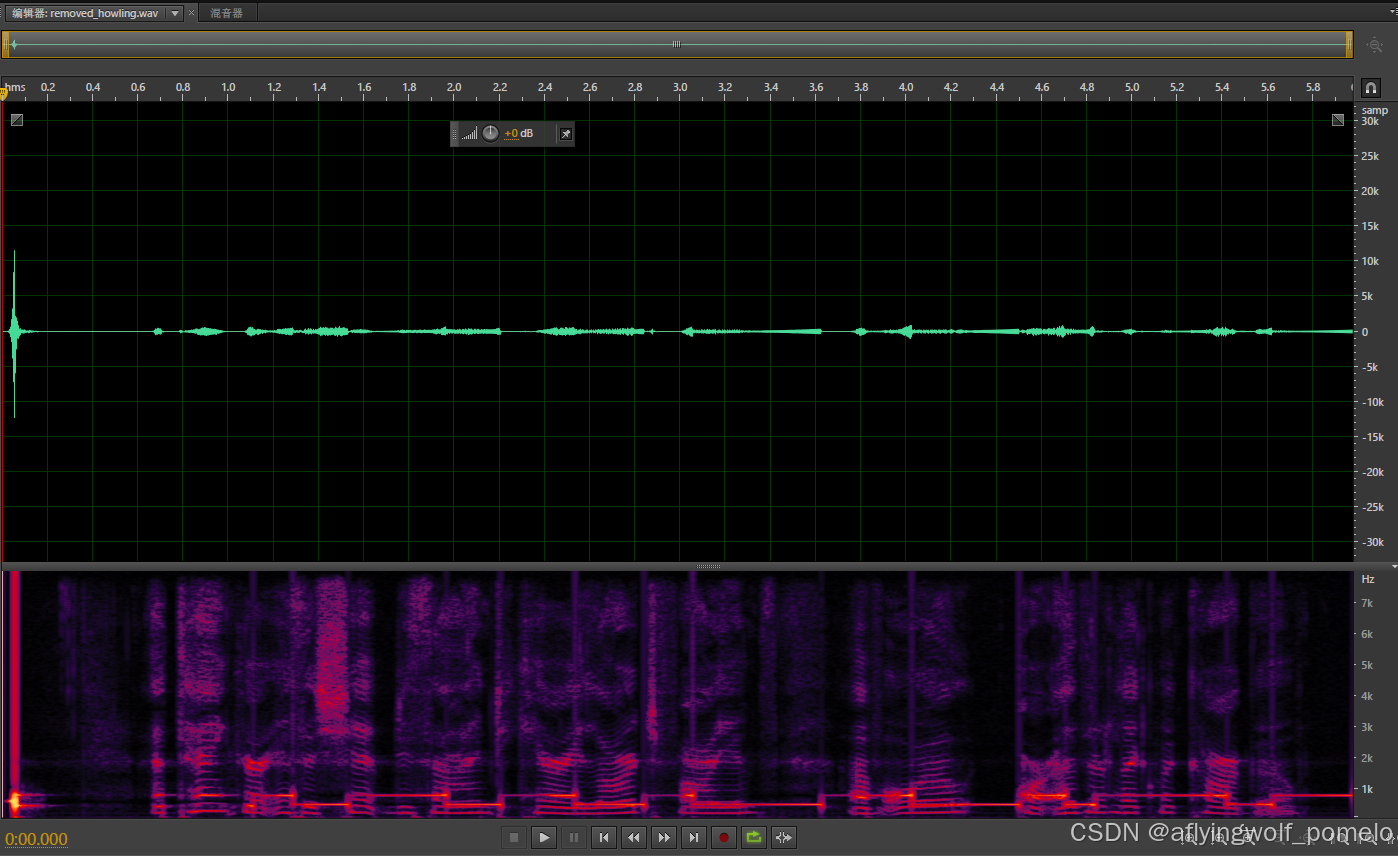
2.6 仿真结果
三、总结
根据我们的实践,该方法效果并不好,这一点和调研结果有一些出入。更多资料和代码可以进入 https://t.zsxq.com/qgmoN 。

中国智能体开发者社区,聚焦智能体与大模型开发,提供前沿资讯、实用工具链、开源项目及行业案例。通过技术沙龙、开发者大赛等活动,促进经验交流与协作,助力开发者快速构建创新智能应用。
更多推荐


 20
20 0
0- 0


 已为社区贡献7条内容

所有评论(0)