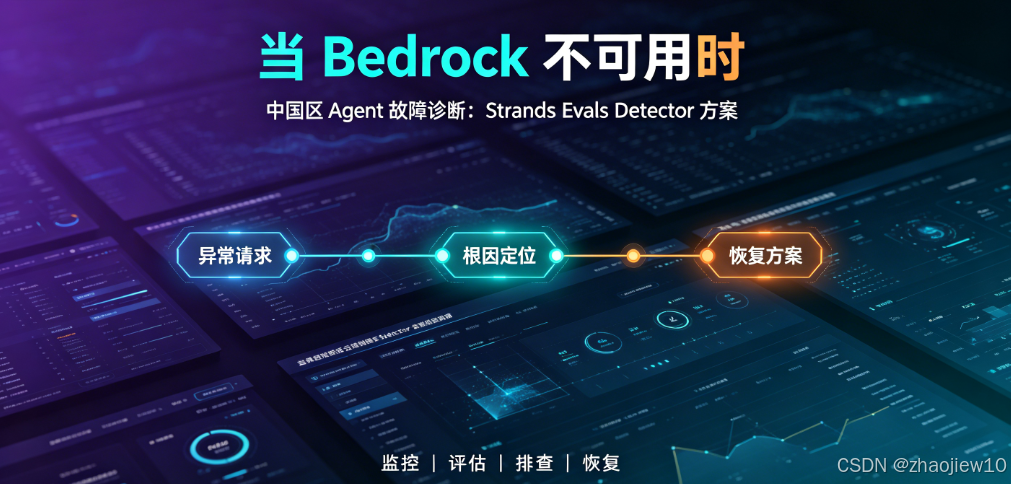
当 Bedrock 不可用时,在中国区使用Strands Evals Detector进行Agent故障诊断的方案
Detector 是什么
想象你管理一个 AI Agent 服务。用户说这个 agent 今天表现很差,你看监控面板:成功率从 95% 掉到 78%。但监控只能告诉你分数掉了,不能告诉你为什么掉了。你想深入分析,打开 trace 日志——每天几千条 trace,每条几十个 span,每个 span 包含 agent 的每轮思考、每次工具调用、每次 LLM 对话。人工逐条看不可能。
Strands Evals Detector 就是这个场景的答案。它像医院的病理科:你把 agent 的执行 session(一次完整对话的 span 树)送进去,它告诉你具体哪里病了、什么病、怎么治。
Session 是什么?想象 agent 和用户的一次完整对话。Agent 先理解用户需求(第 1 个 span),决定调用 weather 工具查天气(第 2 个 span,工具调用),LLM 根据天气结果生成回复(第 3 个 span),最后把回复返回给用户(第 4 个 span)。这四个操作按时间顺序排列,形成一棵树——这就是 session,也就是 span 树。Detector 分析的就是这棵树。
Detector 跑两阶段流水线。
- Phase 1 的
detect_failures逐 span 检查,对照预定义的失败类别打标——比如第 2 个 span 工具调用超时,标记为execution-error-category-timeout;第 3 个 span LLM 虚构了一个不存在的方法,标记为hallucination-category-hall-capabilities。 - Phase 2 的
analyze_root_cause把这些失败按因果链串起来:工具超时是根因(PRIMARY),导致 agent 不得不编造回复(SECONDARY),最后用户不满意(TERTIARY)。修复建议也分层——根因层加超时重试,连锁反应层改进 fallback 策略。
Detector 的入口函数 diagnose_session(session, model=...) 把两阶段串起来。session 是 span 树,model 是做分析的 LLM。输出是结构化的诊断结果:哪个 span 失败、什么类别、置信度多高、证据在哪、根因是什么、怎么修复。
这套能力在全球区开箱即用,但前提是 Amazon Bedrock 可用。Detector 的 LLM 推理默认走 Bedrock,diagnose_session 的 model 参数如果是字符串(比如 "claude-3-sonnet")会被包成 BedrockModel。而 trace 的数据源全球区默认走 Bedrock AgentCore runtime,从 /aws/bedrock-agentcore/runtimes/ log group 读取 body.input/output 格式。中国区没有 Bedrock,既无该 LLM 提供商,也无该 trace 数据源。
中国区(cn-north-1 / cn-northwest-1)没有 Bedrock。三层依赖全部断裂。本文记录我们在 cn-north-1 上用智谱 GLM-4.7 替代 Bedrock 推理、自建格式桥接替代 AgentCore 转换层的完整验证过程。
Bedrock 在中国区的适配
两阶段流水线的入口 diagnose_session(session, model=...) 有两个关键参数。
session从哪来?Agent 运行时通过 OpenTelemetry 把 span 写入 CloudWatch Logs,后续CloudWatchProvider用 Logs Insights 查询读回,再由 mapper 转成Session对象。model怎么解析?由内部的_resolve_model决定。
这两个环节里各藏着 Bedrock 的影子。深入看发现 Bedrock 渗透在三个层面。
模型层
_resolve_model 负责把 model 参数解析成 Strands SDK 的 Model 实例。Model 是 SDK 的模型抽象,BedrockModel、OpenAIModel 等都实现这个接口。代码逻辑有两个 Bedrock 回退路径:
def _resolve_model(model: Model | str | None) -> Model:
    if model is None:
        return BedrockModel(model_id=DEFAULT_DETECTOR_MODEL)
    if isinstance(model, str):
        return BedrockModel(model_id=model)
    return model # 需要绕过bedrock
strands-evals diagnose --model gpt-4o 传入字符串会被包成 BedrockModel,中国区静默失败。必须传 Model 实例(如 OpenAIModel)。
数据层
Agent 运行时产生的 OTel span 使用 gen_ai.* 语义约定,这是OpenTelemetry 社区为 GenAI 场景定义的标准属性前缀,消息内容嵌在 gen_ai.user.message、gen_ai.choice 等 span event 里。
但 CloudWatchProvider 从 CWLog 拉数据时,实际的数据流是:CloudWatchProvider 用 Logs Insights 查询原始日志 → CloudWatchLogsParser 解析并规范化 → Mapper 转成 Session。Provider 期望的是 Bedrock Converse API 的 body.input/output 格式:
// Strands 产出(gen_ai.* 标准)
{
  "attributes": {
    "gen_ai.operation.name": "chat"
  },
  "events": [
    {
      "name": "gen_ai.user.message",
      "attributes": {
        "content": "..."
      }
    }
  ]
}

// CloudWatchProvider 期望(Bedrock 私有)
{
  "body": {
    "input": {
      "messages": [
        {
          "role": "user",
          "content": {
            "text": "..."
          }
        }
      ]
    },
    "output": {
      "messages": [...]
    }
  }
}
两种格式毫无关联。全球区使用 Bedrock AgentCore runtime 时,CloudWatchProvider 从 /aws/bedrock-agentcore/runtimes/ log group 读取 body.input/output 格式。中国区没有 Bedrock,该数据源不可用。
类型层
即使数据进了 CWLog 并被读回,还需要 mapper 转成 Session。detect_otel_mapper 根据 span 的 scope.name 自动选择 mapper——检测到 "strands.telemetry.tracer" 就选 StrandsInMemorySessionMapper。
但这个 mapper 的签名是 map_to_session(data: list[ReadableSpan])。ReadableSpan 是 OpenTelemetry SDK 的内存对象,内部直接访问 span.context.trace_id、span.events 等属性。CWLog 拉回的是 JSON dict,没有这些属性,会触发 AttributeError。
这个问题在格式桥接部分解决——用适配器模式把 dict 包装成 ReadableSpan 鸭子类型。
Detector 的十大类三十三细分
Detector 能识别什么病?这取决于它的 Prompt 里定义的失败类别。Prompt 位于 src/strands_evals/detectors/prompt_templates/failure_detection/failure_detection_v0.py,定义了十个父类别、三十三个细分类别,覆盖 AI Agent 失败的全谱系。
执行错误(execution-error)
最常见的一类,涵盖工具调用层面的各种失败:
- authentication:凭证或权限问题(401/403)。Agent 调用天气 API 返回「Invalid API key」
- resource-not-found:资源不存在(404)。查询「北京」天气但 API 只支持国内城市
- service-errors:上游服务失败(500)。天气服务本身宕机
- rate-limiting:请求频率超限(429)。1 分钟内调用 100 次被限流
- formatting:输出格式错误。LLM 返回的 JSON 缺了右括号
- timeout:操作超时。30 秒没收到响应
- resource-exhaustion:资源耗尽。内存不足导致处理失败
- environment:环境配置缺失。
OPENAI_API_KEY未设置 - tool-schema:工具输入输出不匹配 schema。Required 字段缺失
幻觉(hallucination)
LLM 特有的「编造」行为:
- hall-capabilities:声称使用不存在的能力。「我用 AI 图像生成器画了一张图」——但根本没有这个工具
- hall-usage:声称使用了没使用的工具。「我已查询天气」——实际未调用 API
- hall-history:引用不存在的对话历史。「你之前说过要去巴黎」——用户从没提过
- hall-params:使用与上下文冲突的参数。用户说「飞北京」,agent 却查询「上海」
- fabricate-tool-outputs:伪造工具输出。编造「天气晴朗」但 API 返回错误
- hall-misunderstand:误解工具响应。把错误码当成成功处理
编排错误(orchestration-related-errors)
任务规划层的失败:
- reasoning-mismatch:推理与执行脱节。计划验证身份但实际跳过直接回复
- goal-deviation:偏离原始目标。简单查询变成复杂分析,越走越远
- premature-termination:提前终止。还没确认支付就结束对话
- unaware-termination:未识别完成信号。任务已完成却继续问「还需要什么」
错误动作(incorrect-actions)
工具使用策略失误:
- tool-selection:选错工具。用
general_search()查航班(应该用check_flight_status()) - poor-information-retrieval:工具使用不当。搜索关键词太泛,返回无关结果
- clarification:信息不完整却继续。没确认日期就预订酒店
- inappropriate-info-request:不当信息请求。问用户「汇率多少」但自己有 currency_api
重复行为(repetitive-behavior)
无意义的循环:
- repetition-tool:重复调用同一工具。连续 3 次
check_flight_status(flight_id="123") - repetition-info:重复请求用户提供过的信息。再次问「您要去哪里」(用户已说过)
- step-repetition:重复工作流步骤。验证步骤执行了 3 遍
任务指令(task-instruction)
指令遵从问题:
- non-compliance:不遵从指令。系统提示「先认证再操作」,agent 直接操作
- problem-id:路径选择错误。知道要修 SQL 缩进,却打开了错误的文件
上下文处理错误(context-handling-error)
记忆断层:
- context-handling-failures:突然丢失上下文。正在处理预订,突然问「您好,有什么可以帮您」
LLM 输出问题(llm-output)
输出质量异常:
- nonsensical:无意义输出。回复包含「根据我的系统提示…」或
[MASK]占位符
配置不匹配(configuration-mismatch)
系统配置错误:
- tool-definition:工具定义不符。声明是计算器,实际做搜索
编码场景特有错误(coding-use-case-specific-failure-types)
代码生成场景专用:
- edge-case-oversights:未处理边界条件
- dependency-issues:依赖处理失败
这三十三个类别可以叠加。一个 span 可能同时有多个失败——比如 agent 伪造工具输出(hallucination)且重复了三次(repetitive-behavior)。Detector 会同时标记,并给出各自的置信度和证据。
核心验证
第一步是要确认核心路径能用非 Bedrock 模型跑通。写一个会故意失败的 demo agent——配一个会抛 ConnectionError 的 weather 工具,让 agent 调用失败。trace 走纯内存路径,detector 用 OpenAIModel 实例指向GLM-4.7。
telemetry = StrandsEvalsTelemetry().setup_in_memory_exporter()
ctx = baggage.set_baggage("session.id", session_id)
token = context.attach(ctx)
agent = build_agent()  # OpenAIModel(GLM-4.7)
result = agent("What's the weather in Beijing?")
context.detach(token)

spans = list(telemetry.in_memory_exporter.get_finished_spans())
session = StrandsInMemorySessionMapper().map_to_session(spans, session_id)
diagnosis = diagnose_session(session, model=build_model())  # Model 实例,不是字符串
运行结果:
6 spans captured, 4 mapped to Session
detect_failures → execution-error-category-service-errors, confidence=0.90
  Evidence: ConnectionError - Weather service unavailable
analyze_root_cause → PRIMARY_FAILURE
  Fix: Implement retry logic with exponential backoff + fallback data sources
→ China-region core path: VALIDATED ✓
_resolve_model 收到 OpenAIModel 实例直接 pass-through,没碰 BedrockModel。Phase 1 的 streaming 文本模式检测和 Phase 2 的 structured output 根因分析都在 GLM-4.7 上正常工作。十个父类别中的 execution-error-category-service-errors 被正确识别,置信度 0.90。
格式桥接
核心验证绕开了 CWLog——spans 直接走内存,不碰 CloudWatch。但生产环境需要持久化存储和事后分析,必须打通 Agent → CWLog → Detector 这条链路。
问题本质:三种断裂
打通链路时遇到三个断裂点,每个都需要桥接:
断裂 1:格式转换
Strands SDK 用 gen_ai.* OTEL 标准格式(gen_ai.user.message、gen_ai.choice),CloudWatchProvider 期望 body.input/output Bedrock 格式。全球区从 /aws/bedrock-agentcore/runtimes/ 读后者,中国区无此数据源,必须自己写转换。
断裂 2:Events 覆盖
CloudWatchLogsParser 会把 span 的嵌入式 events 用独立 event 记录覆盖:
span["span_events"] = events_by_span_id.get(span_id, []) # 覆盖,不合并
如果 events 嵌在 span 记录里,这行代码把它们替换成空列表,导致 messages 丢失。
断裂 3:类型失配
StrandsInMemorySessionMapper 期望 list[ReadableSpan]——OpenTelemetry SDK 的内存对象,直接访问 span.context.trace_id、span.events 等属性。CWLog 拉回的是 JSON dict,没有这些属性,触发 AttributeError。
桥接方案:写入端
解决断裂 1 和 2,把 spans 按正确格式写入 CWLog:
def spans_to_cwlog_records(spans, session_id=""):
    records = []
    for span in spans:
        attrs = dict(span.attributes) if span.attributes else {}
        if session_id:
            attrs["session.id"] = session_id
            attrs["session"] = {"id": session_id}  # CWLog Insights 查询需要

        # Span 记录(有 startTime → _is_span() = True)
        records.append({
            "traceId": format(span.context.trace_id, "032x"),
            "spanId": format(span.context.span_id, "016x"),
            "startTimeUnixNano": str(span.start_time),
            "attributes": attrs,
            "scope": {"name": span.instrumentation_scope.name}
        })

        # Event 记录(有 event.name → _is_event() = True,按 spanId 关联)
        for event in span.events or []:
            event_attrs = {"event.name": event.name}
            event_attrs.update(dict(event.attributes or {}))
            if session_id:
                event_attrs["session"] = {"id": session_id}
            records.append({
                "spanId": format(span.context.span_id, "016x"),
                "attributes": event_attrs
            })
    return records
实际写入 CWLog 的记录示例(一个 InferenceSpan + 两个 event):
// Span 记录(_is_span() = True,因为有 startTimeUnixNano)
{
  "traceId": "a1b2c3d4e5f678901234567890123456",
  "spanId": "1234567890abcdef",
  "startTimeUnixNano": "1751073200000000000",
  "endTimeUnixNano": "1751073201000000000",
  "attributes": {
    "gen_ai.system": "openai",
    "gen_ai.operation.name": "chat",
    "session.id": "e2e-20250627-001",
    "session": {"id": "e2e-20250627-001"}
  },
  "scope": {"name": "strands.telemetry.tracer"}
}

// Event 记录 1(_is_event() = True,因为有 event.name)
{
  "spanId": "1234567890abcdef",
  "attributes": {
    "event.name": "gen_ai.user.message",
    "gen_ai.user.message": "What's the weather in Beijing?",
    "session": {"id": "e2e-20250627-001"}
  }
}

// Event 记录 2
{
  "spanId": "1234567890abcdef",
  "attributes": {
    "event.name": "gen_ai.choice",
    "gen_ai.choice": "I'll check the weather for you.",
    "session": {"id": "e2e-20250627-001"}
  }
}
关键设计:
- span 记录和 event 记录独立写入,通过
spanId关联,避免覆盖 session.idflat key 供 mapper 查找,session.idnested dict 供 CWLog Insights 查询(filter attributes.session.id)- CWLog JSON 序列化要求,
_DictSpanAdapter读取时转int()
同一个 session 的所有记录写入同一个 Log Stream(session-{session_id}),比如 session-e2e-20250627-001。CloudWatch Logs 中查询该 session 的所有 span 和 event:
# 实际写入调用
client.put_log_events(
    logGroupName="/aws/agents/cn-eval-test",
    logStreamName="session-e2e-20250627-001",
    logEvents=[
        {"timestamp": 1751073200000, "message": json.dumps(span_record)},
        {"timestamp": 1751073200001, "message": json.dumps(event_record)},
        # ... 共 6 条
    ]
)

query = "filter attributes.session.id like 'e2e-20250627-001'"
# 返回该 Log Stream 内所有匹配记录
桥接方案:读取端
主要解决类型层的断裂(CWLog 拉回 JSON dict,但 StrandsInMemorySessionMapper 期望 ReadableSpan 对象)——用适配器模式把 dict 包装成 ReadableSpan 鸭子类型,让 mapper 无需修改就能读取 CWLog 数据:
class _DictSpanAdapter:
    """把 dict 包成 ReadableSpan 鸭子类型,复用父类 460 行逻辑"""
    def __init__(self, data: dict):
        self.name = data.get("name", "")
        # CWLog 的 startTimeUnixNano 是字符串,父类做 start_time / 1e9 需要 int
        self.start_time = int(data.get("start_time", 0)) or 0
        self.end_time = int(data.get("end_time", 0)) or 0
        self.attributes = data.get("attributes") or {}
        # hex string → int,父类做 format(trace_id, "032x") 需要 int
        self.context = SimpleNamespace(
            trace_id=int(data.get("trace_id", "0"), 16),
            span_id=int(data.get("span_id", "0"), 16))
        self.parent = SimpleNamespace(
            span_id=int(data.get("parent_span_id", "0"), 16)) \
            if data.get("parent_span_id") else None
        self.events = [_DictEventAdapter(e) for e in data.get("span_events") or []]

class StrandsCloudWatchSessionMapper(StrandsInMemorySessionMapper):
    def map_to_session(self, data: list[dict], session_id: str) -> Session:
        adapted = [_DictSpanAdapter(d) for d in data]
        return super().map_to_session(adapted, session_id)
桥接过程中还遇到时间戳字符串转换、点号嵌套解析等细节问题,都在代码注释中标注了解决方案。
验证结果
验证完整的 Agent → CWLog → Detector 链路。Agent 配置故意失败的天气工具(ConnectionError),trace 写入 CWLog(cn-north-1),Detector 从 CWLog 读取并诊断。
Agent 执行日志
[2026-06-27T16:45:12] Agent started | session_id=e2e-20250627-001
[2026-06-27T16:45:13] Calling tool: weather_api(city="Beijing")
[2026-06-27T16:45:13] Tool error: ConnectionError - Weather service unavailable
[2026-06-27T16:45:14] LLM generating response with error context
[2026-06-27T16:45:15] Agent completed | 4 spans, 6 events

→ Writing to CWLog: /aws/agents/cn-eval-test
→ 6 records written (2 span + 4 event)
→ Waiting for Logs Insights indexing...
CloudWatch 查询日志
attempt=<1> | CWLog indexing not ready, retrying in 5s...
attempt=<2> | CWLog indexing not ready, retrying in 5s...
attempt=<3> | trace_count=<1>, span_count=<4> | read from CWLog ✓

Query: filter attributes.session.id like 'e2e-20250627-001'
Results: 6 records (2 spans + 4 events)
- span: InferenceSpan (gen_ai.system=openai, gen_ai.operation.name=chat)
- span: ToolExecutionSpan (tool.name=weather_api)
- span: InferenceSpan (error handling)
- span: AgentInvocationSpan (completion)
Detector 诊断结果
=== FAILURE DETECTION ===
Location: span_2 (ToolExecutionSpan)
Category: execution-error-category-service-errors
Confidence: 0.90
Evidence: ConnectionError - Weather service unavailable

Location: span_3 (InferenceSpan)
Category: task-instruction-category-non-compliance
Confidence: 0.75
Evidence: Agent did not retry or use fallback after tool failure

=== ROOT CAUSE ANALYSIS ===
Primary Failure: Tool execution error (ConnectionError)
Secondary Effect: Agent proceeded without proper error handling
Tertiary Effect: User received incomplete response

Fix Recommendation:
  Type: system_prompt
  Action: Add retry logic with exponential backoff and fallback data sources
  Code: Implement @retry decorator on weather_api tool
Mapper 单元测试对比
桥接方案的核心假设是:把 dict 包装成 ReadableSpan 鸭子类型,mapper 应该产出和原生路径完全一致的结果。如果这个假设不成立,整个格式桥接就是不可靠的。
对比设计:
- Path A(原生路径):
InMemorySpanExporter→StrandsInMemorySessionMapper - Path B(桥接路径):
CwLogSpanExporter→CloudWatchLogsParser→_DictSpanAdapter→StrandsInMemorySessionMapper
两条路径喂给同一个 mapper,对比输出:_DictSpanAdapter 没有丢失或篡改数据,桥接后的数据流和原生数据流等价,可以放心使用
Path A (ReadableSpan 原生): 4 spans
  - InferenceSpan: prompt="What's the weather?", response=ToolCall(weather_api)
  - ToolExecutionSpan: error=ConnectionError
  - InferenceSpan: error_context="Service unavailable"
  - AgentInvocationSpan: completion="Sorry..."

Path B (CWLog → dict → adapter): 4 spans
  - InferenceSpan: prompt="What's the weather?", response=ToolCall(weather_api)
  - ToolExecutionSpan: error=ConnectionError
  - InferenceSpan: error_context="Service unavailable"
  - AgentInvocationSpan: completion="Sorry..."

✓ Session equivalence: PASS
✓ Span count: 4 == 4
✓ Types match: InferenceSpan, ToolExecutionSpan, InferenceSpan, AgentInvocationSpan
✓ Messages extracted: 6 user messages, 4 assistant messages
三层全部通过。核心路径产出 1 个 failure(execution-error-category-service-errors,0.90)和 1 个 root cause(PRIMARY + 修复建议)。Mapper 单元测试两条路径 Session 完全一致(4==4 spans,类型/ID/prompt/response 全匹配)。
结语
走到这里,最初的三个窟窿都被堵上了。
- 模型层的问题最简单——绕过
_resolve_model的 Bedrock 回退,直接把OpenAIModel实例喂给diagnose_session,GLM-4.7 就能正常产出失败检测和根因分析。 - 数据层的问题最繁琐——CloudWatch Logs 的格式、索引、点号解析,每个细节都要对齐。
- 类型层的问题最巧妙——
_DictSpanAdapter用 Python 的鸭子类型,让 JSON dict 冒充ReadableSpan,复用既有 mapper 而不重写。
中国区没有 Bedrock,但只要有 OpenAI-compatible 的 endpoint,Detector 就能跑。没有 AgentCore 的格式转换,但只要在写入端和读取端各加一层薄桥接,数据就能流通。

中国智能体开发者社区,聚焦智能体与大模型开发,提供前沿资讯、实用工具链、开源项目及行业案例。通过技术沙龙、开发者大赛等活动,促进经验交流与协作,助力开发者快速构建创新智能应用。
更多推荐
 0
0 0
0- 0


 已为社区贡献12条内容

所有评论(0)