ubuntu部署whisper+speaker_large+qwen【gradio界面版】
·
上文已经完成ubutun部署whisper+speaker+qwen3-1.7B,现采用gradio实现界面,本意是想通过tkinter创建ui界面,之后通过pyinstaller将其打包为可执行文件,但因其一直报错,未解决,则暂时采用gradio实现。
python struct.error: 'i' format requires -2147483648 <= number <= 2147483647
最终的实现界面如下图所示: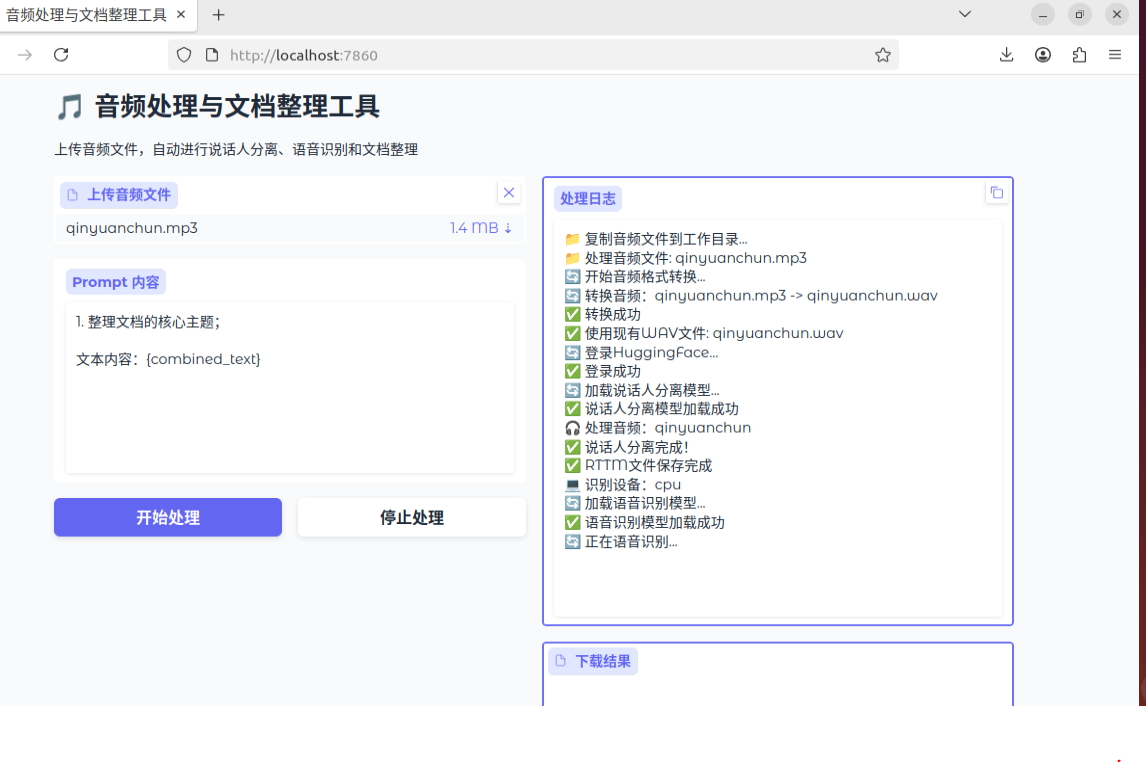
安装依赖:
pip install gradio torch transformers pyannote.audio huggingface_hub
全部代码如下:
import os
import json
import gradio as gr
import subprocess
import torch
import huggingface_hub
from pyannote.audio import Pipeline
from transformers import AutoModelForSpeechSeq2Seq, AutoProcessor, pipeline
from transformers import AutoModelForCausalLM, AutoTokenizer
import warnings
import tempfile
import shutil
# 屏蔽不必要的警告
warnings.filterwarnings("ignore")
# 设置镜像
os.environ["HF_ENDPOINT"] = "https://hf-mirror.com"
class AudioProcessorGradio:
def __init__(self):
self.is_running = False
self.current_process = None
def extract_and_filter_text(self, json_data):
"""从对齐后的JSON数据中提取文本,过滤无关平台话术"""
irrelevant_keywords = [
"点赞", "订阅", "转发", "打赏", "小红书", "抖音",
"YoYo Television Series Exclusive", "孔优优独播剧场",
"中文字幕志愿者", "李宗盛"
]
all_text = []
for item in json_data:
text = item.get("text", "").strip()
if text and not any(keyword in text for keyword in irrelevant_keywords):
all_text.append(text)
return " ".join(all_text)
def process_document(self, aligned_json_path, prompt, combined_text):
"""加载对齐结果,调用Qwen模型完成文档整理并保存"""
if not os.path.exists(aligned_json_path):
return f"❌ 对齐结果文件不存在:{aligned_json_path}"
with open(aligned_json_path, "r", encoding="utf-8") as f:
json_data = json.load(f)
combined_text = self.extract_and_filter_text(json_data)
if not combined_text:
return "⚠️ 过滤后无有效文本,跳过文档整理步骤"
yield "🔄 加载文档整理模型(Qwen3-1.7B)..."
model_name = "Qwen/Qwen3-1.7B"
try:
tokenizer = AutoTokenizer.from_pretrained(model_name)
model = AutoModelForCausalLM.from_pretrained(
model_name,
torch_dtype=torch.float16 if torch.cuda.is_available() else torch.float32,
device_map="auto"
)
yield "✅ 文档整理模型加载成功"
except Exception as e:
return f"❌ 模型加载失败:{str(e)}"
# 处理prompt
prompt = prompt.replace("{combined_text}", combined_text)
messages = [{"role": "user", "content": prompt}]
text = tokenizer.apply_chat_template(
messages,
tokenize=False,
add_generation_prompt=True
)
model_inputs = tokenizer([text], return_tensors="pt").to(model.device)
generated_ids = model.generate(
**model_inputs,
max_new_tokens=512,
temperature=0.3,
do_sample=True
)
generated_ids = generated_ids[0][len(model_inputs.input_ids[0]):]
result = tokenizer.decode(generated_ids, skip_special_tokens=True).strip()
output_content = f"=== 文档整理结果 ===\n{result}"
yield output_content
def combine_results(self, rttm_file_path, asr_result, min_segment_duration=0.5):
"""优化匹配逻辑:去重+时间戳修正+重叠最优匹配"""
# 1. 读取并过滤RTTM片段(<0.5秒的噪声片段)
rttm_data = []
with open(rttm_file_path, 'r', encoding='utf-8') as rttm_file:
for line in rttm_file.readlines():
parts = line.strip().split()
if len(parts) < 9:
continue
start = float(parts[3])
duration = float(parts[4])
end = start + duration
speaker = parts[7]
if duration >= min_segment_duration:
rttm_data.append({
"start": start,
"end": end,
"speaker": speaker,
"duration": duration
})
if not rttm_data:
return []
# 2. 读取并过滤ASR文本块(去重+时间戳修正)
asr_chunks = []
seen_text = set()
for chunk in asr_result.get("chunks", []):
if not chunk.get("timestamp") or None in chunk["timestamp"]:
continue
chunk_start, chunk_end = chunk["timestamp"]
# 修正时间戳顺序
if chunk_start > chunk_end:
chunk_start, chunk_end = chunk_end, chunk_start
duration = chunk_end - chunk_start
if duration < 0.3:
continue
text = chunk["text"].strip()
# 文本去重(忽略空格和标点差异)
clean_text = text.replace(" ", "").replace(",", "").replace("。", "").replace("!", "")
if clean_text not in seen_text and len(clean_text) > 1:
seen_text.add(clean_text)
asr_chunks.append({
"start": chunk_start,
"end": chunk_end,
"text": text,
"duration": duration
})
if not asr_chunks:
return []
# 3. 重叠度优先匹配(仅取最优说话人)
combined_results = []
for asr in asr_chunks:
asr_start, asr_end = asr["start"], asr["end"]
matched_segments = []
# 计算与所有说话人片段的重叠度
for seg in rttm_data:
seg_start, seg_end = seg["start"], seg["end"]
overlap_start = max(asr_start, seg_start)
overlap_end = min(asr_end, seg_end)
overlap_duration = max(0.0, overlap_end - overlap_start)
overlap_ratio = overlap_duration / asr["duration"] if asr["duration"] > 0 else 0
if overlap_ratio > 0.1:
matched_segments.append({
"speaker": seg["speaker"],
"overlap_start": overlap_start,
"overlap_end": overlap_end,
"overlap_ratio": overlap_ratio
})
# 处理匹配结果
if not matched_segments:
combined_results.append({
"start_time": asr_start,
"end_time": asr_end,
"speaker": "UNKNOWN",
"text": asr["text"]
})
else:
# 按重叠度排序,仅取最高的
matched_segments.sort(key=lambda x: x["overlap_ratio"], reverse=True)
top_seg = matched_segments[0]
combined_results.append({
"start_time": top_seg["overlap_start"],
"end_time": top_seg["overlap_end"],
"speaker": top_seg["speaker"],
"text": asr["text"]
})
# 4. 合并同一说话人连续片段(增强去重)
if not combined_results:
return []
merged = [combined_results[0]]
for curr in combined_results[1:]:
last = merged[-1]
if (curr["speaker"] == last["speaker"] and
curr["start_time"] - last["end_time"] < 1.0):
last["end_time"] = curr["end_time"]
# 文本去重:避免重复添加相同内容
if curr["text"] not in last["text"]:
last["text"] += " " + curr["text"]
else:
merged.append(curr)
return merged
def convert_to_wav(self, input_path, output_dir):
"""转换音频为16kHz单声道WAV(修复时间戳偏移)"""
filename = os.path.splitext(os.path.basename(input_path))[0]
wav_path = os.path.join(output_dir, f"{filename}.wav")
yield f"🔄 转换音频:{os.path.basename(input_path)} -> {os.path.basename(wav_path)}"
try:
cmd = [
"ffmpeg", "-y", "-i", input_path,
"-ar", "16000", "-ac", "1", "-c:a", "pcm_s16le",
"-avoid_negative_ts", "make_zero",
wav_path
]
result = subprocess.run(
cmd, stdout=subprocess.PIPE, stderr=subprocess.PIPE, text=True
)
if result.returncode != 0:
yield f"❌ ffmpeg错误:{result.stderr}"
return None
yield f"✅ 转换成功"
return wav_path
except Exception as e:
yield f"❌ 转换失败:{str(e)}"
return None
def process_audio_gradio(self, audio_file_path, prompt_text):
"""Gradio主处理函数"""
if self.is_running:
yield "⚠️ 已有处理任务正在进行中,请等待完成", None
return
self.is_running = True
output_content = ""
output_file_path = None
def add_output(text):
nonlocal output_content
output_content += text + "\n"
return output_content, None
try:
# 创建临时工作目录
with tempfile.TemporaryDirectory() as temp_dir:
# 检查文件是否已经在临时目录中
if not audio_file_path.startswith(temp_dir):
# 文件不在临时目录中,需要复制
audio_filename = os.path.basename(audio_file_path)
new_audio_path = os.path.join(temp_dir, audio_filename)
yield add_output(f"📁 复制音频文件到工作目录...")
shutil.copy2(audio_file_path, new_audio_path)
audio_path = new_audio_path
else:
# 文件已经在临时目录中
audio_path = audio_file_path
yield add_output(f"📁 处理音频文件: {os.path.basename(audio_path)}")
# 基础校验
if not os.path.exists(audio_path):
yield add_output(f"❌ 音频文件不存在:{audio_path}")
return
# 检查ffmpeg
try:
subprocess.run(["ffmpeg", "-version"], stdout=subprocess.PIPE, stderr=subprocess.PIPE, check=True)
except (FileNotFoundError, subprocess.CalledProcessError):
yield add_output("❌ 未找到ffmpeg或版本不兼容,请先安装ffmpeg")
return
# 转换音频
yield add_output("🔄 开始音频格式转换...")
conversion_results = []
for result in self.convert_to_wav(audio_path, temp_dir):
conversion_results.append(result)
yield add_output(result)
wav_path = None
for result in conversion_results:
if isinstance(result, str) and result.endswith('.wav') and os.path.exists(result):
wav_path = result
break
if not wav_path:
# 如果没有找到wav文件,尝试在临时目录中查找
audio_filename = os.path.splitext(os.path.basename(audio_path))[0]
possible_wav_path = os.path.join(temp_dir, f"{audio_filename}.wav")
if os.path.exists(possible_wav_path):
wav_path = possible_wav_path
yield add_output(f"✅ 使用现有WAV文件: {os.path.basename(wav_path)}")
else:
yield add_output("❌ 音频转换失败,未生成WAV文件")
return
audio_filename = os.path.splitext(os.path.basename(wav_path))[0]
rttm_filename = os.path.join(temp_dir, f"{audio_filename}.rttm")
aligned_json = os.path.join(temp_dir, f"{audio_filename}_combined_aligned.json")
asr_json = os.path.join(temp_dir, f"{audio_filename}_asr_with_timestamps.json")
output_txt = os.path.join(temp_dir, f"{audio_filename}_result.txt")
# 1. 说话人分离
token = "hf_TBTbupvBJJoh#############"
try:
yield add_output("🔄 登录HuggingFace...")
huggingface_hub.login(token=token)
yield add_output(f"✅ 登录成功")
yield add_output("🔄 加载说话人分离模型...")
diarization_pipeline = Pipeline.from_pretrained(
"pyannote/speaker-diarization-3.1", token=token
)
yield add_output("✅ 说话人分离模型加载成功")
# 执行分离
yield add_output(f"🎧 处理音频:{audio_filename}")
diarization_result = diarization_pipeline(wav_path)
yield add_output("✅ 说话人分离完成!")
# 生成RTTM(过滤<0.5秒片段)
speaker_segments = diarization_result.speaker_diarization
with open(rttm_filename, "w", encoding='utf-8') as rttm_file:
for segment, _, speaker in speaker_segments.itertracks(yield_label=True):
duration = segment.end - segment.start
if duration >= 0.5:
rttm_line = (
f"SPEAKER {audio_filename} 1 {segment.start:.3f} "
f"{duration:.3f} <NA> <NA> {speaker} <NA> <NA>\n"
)
rttm_file.write(rttm_line)
yield add_output(f"✅ RTTM文件保存完成")
except Exception as e:
yield add_output(f"❌ 说话人分离出错:{str(e)}")
return
# 2. 语音识别
try:
device = "cuda:0" if torch.cuda.is_available() else "cpu"
torch_dtype = torch.float16 if torch.cuda.is_available() else torch.float32
yield add_output(f"💻 识别设备:{device}")
yield add_output("🔄 加载语音识别模型...")
model_id = "openai/whisper-large-v3-turbo"
model = AutoModelForSpeechSeq2Seq.from_pretrained(
model_id, torch_dtype=torch_dtype, low_cpu_mem_usage=True, use_safetensors=True
).to(device)
processor = AutoProcessor.from_pretrained(model_id)
yield add_output("✅ 语音识别模型加载成功")
# 构建ASR流水线
asr_pipeline = pipeline(
"automatic-speech-recognition",
model=model,
tokenizer=processor.tokenizer,
feature_extractor=processor.feature_extractor,
chunk_length_s=30,
batch_size=8,
torch_dtype=torch_dtype,
device=device,
return_timestamps=True,
)
# 执行识别
yield add_output("🔄 正在语音识别...")
asr_result = asr_pipeline(
wav_path,
generate_kwargs={
"language": "chinese",
"task": "transcribe",
}
)
yield add_output("✅ 语音识别完成!")
# ASR结果去重
deduplicated_chunks = []
seen_text = set()
for chunk in asr_result.get("chunks", []):
text = chunk["text"].strip()
clean_text = text.replace(" ", "").replace(",", "").replace("。", "").replace("!", "")
if clean_text not in seen_text and len(clean_text) > 1:
seen_text.add(clean_text)
deduplicated_chunks.append(chunk)
asr_result["chunks"] = deduplicated_chunks
# 保存ASR结果
with open(asr_json, "w", encoding="utf-8") as f:
json.dump(asr_result["chunks"], f, ensure_ascii=False, indent=2)
yield add_output(f"✅ ASR结果保存完成")
except Exception as e:
yield add_output(f"❌ 语音识别出错:{str(e)}")
return
# 3. 时间对齐
yield add_output("🔄 进行时间对齐...")
combined = self.combine_results(rttm_filename, asr_result)
if not combined:
yield add_output("⚠️ 未生成有效匹配结果")
return
# 保存对齐结果
with open(aligned_json, "w", encoding="utf-8") as f:
json.dump(combined, f, ensure_ascii=False, indent=2)
yield add_output(f"✅ 时间对齐完成")
# 4. 文档整理
yield add_output("🔄 开始文档整理...")
with open(aligned_json, "r", encoding="utf-8") as f:
json_data = json.load(f)
combined_text = self.extract_and_filter_text(json_data)
if not combined_text:
yield add_output("⚠️ 过滤后无有效文本,跳过文档整理")
return
# 调用文档整理模型
yield add_output("🔄 调用文档整理模型...")
doc_results = list(self.process_document(aligned_json, prompt_text, combined_text))
for result in doc_results:
yield add_output(result)
# 保存最终结果
final_result = doc_results[-1] if doc_results else "无结果生成"
with open(output_txt, "w", encoding="utf-8") as f:
f.write(final_result)
output_file_path = output_txt
yield add_output("🎉 处理完成!")
yield add_output(f"📁 结果文件已生成")
# 返回最终结果
yield output_content, output_file_path
except Exception as e:
yield add_output(f"❌ 处理过程中出错:{str(e)}"), None
finally:
self.is_running = False
def create_gradio_interface():
"""创建Gradio界面"""
processor = AudioProcessorGradio()
with gr.Blocks(title="音频处理与文档整理工具", theme=gr.themes.Soft()) as demo:
gr.Markdown("# 🎵 音频处理与文档整理工具")
gr.Markdown("上传音频文件,自动进行说话人分离、语音识别和文档整理")
with gr.Row():
with gr.Column(scale=1):
audio_input = gr.File(
label="上传音频文件",
file_types=[".mp3", ".wav", ".m4a", ".aac", ".flac"],
type="filepath"
)
prompt_input = gr.Textbox(
label="Prompt 内容",
lines=8,
value="""1. 整理文档的核心主题;
2. 概括文档大意;
文本内容:{combined_text}""",
placeholder="请输入prompt内容,使用 {combined_text} 作为文本占位符"
)
with gr.Row():
process_btn = gr.Button("开始处理", variant="primary")
stop_btn = gr.Button("停止处理", variant="stop")
with gr.Column(scale=1):
output_log = gr.Textbox(
label="处理日志",
lines=20,
max_lines=50,
interactive=False,
show_copy_button=True
)
download_output = gr.File(
label="下载结果",
interactive=False
)
# 处理函数
def process_audio(audio_file, prompt_text):
if audio_file is None:
yield "❌ 请先上传音频文件", None
return
for log_content, file_path in processor.process_audio_gradio(audio_file, prompt_text):
yield log_content, file_path
def stop_processing():
processor.is_running = False
return "处理已停止", None
# 事件绑定
process_btn.click(
fn=process_audio,
inputs=[audio_input, prompt_input],
outputs=[output_log, download_output]
)
stop_btn.click(
fn=stop_processing,
outputs=[output_log, download_output]
)
return demo
def main():
"""主函数"""
demo = create_gradio_interface()
# 获取本机IP地址,允许局域网访问
try:
import socket
hostname = socket.gethostname()
local_ip = socket.gethostbyname(hostname)
print(f"🚀 服务启动中...")
print(f"📱 本地访问: http://localhost:7860")
print(f"🌐 局域网访问: http://{local_ip}:7860")
except:
print(f"🚀 服务启动中...")
print(f"📱 本地访问: http://localhost:7860")
print("⏹️ 按 Ctrl+C 停止服务")
# 启动Gradio服务,允许局域网访问
demo.launch(
server_name="0.0.0.0", # 允许所有网络接口访问
server_port=7860,
share=False, # 不创建公共链接
inbrowser=True # 自动打开浏览器
)
if __name__ == "__main__":
main()

中国智能体开发者社区,聚焦智能体与大模型开发,提供前沿资讯、实用工具链、开源项目及行业案例。通过技术沙龙、开发者大赛等活动,促进经验交流与协作,助力开发者快速构建创新智能应用。
更多推荐



 2
2 0
0- 0


 已为社区贡献3条内容

所有评论(0)