数据库+LLM实践1
·
这段时间在处理市政热线的12345的民诉记录文本,大模型的语言理解能力可以简化大文本处理过程。
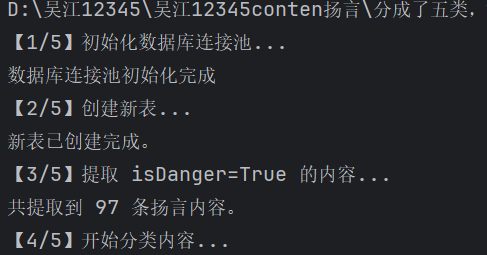
民诉文本记录在content列表里面,入库的时候”扬言“类型的工单已经被isDanger布尔类型标记,共计97条。
1文本提取
我需要将被标记“扬言”工单的进行标记为具体类型,首先将“扬言”类型的文本提取出来交给deepseek看初步判断主要存在哪些类型。
import psycopg2
from psycopg2.pool import ThreadedConnectionPool
import threading

# PostgreSQL 参数(使用您的配置)
DB_HOST = "localhost"
DB_PORT = 5432
DB_NAME = "        DB      "
DB_USER = "postgres"
DB_PASSWORD = "12345"
DB_TABLE = "     table       "

# 全局连接池
conn_pool = None

def init_connection_pool():
    global conn_pool
    conn_pool = ThreadedConnectionPool(
        1, 10,
        host=DB_HOST,
        port=DB_PORT,
        database=DB_NAME,
        user=DB_USER,
        password=DB_PASSWORD
    )
    print("连接池初始化完成")

def extract_dangerous_content_to_txt():
    """提取 isDanger=true 的 content 到 txt 文件"""
    conn = conn_pool.getconn()
    try:
        cur = conn.cursor()

        # 查询 isDanger=true 的 content
        cur.execute(f'SELECT "content" FROM {DB_TABLE} WHERE "isDanger" = true;')
        dangerous_contents = cur.fetchall()

        # 写入 txt 文件
        with open('dangerous_contents.txt', 'w', encoding='utf-8') as f:
            for i, (content,) in enumerate(dangerous_contents, 1):
                if content:  # 确保 content 不为空
                    f.write(f"=== 记录 {i} ===\n")
                    f.write(str(content) + '\n')
                    f.write("=" * 50 + '\n\n')

        cur.close()

        print(f"成功提取 {len(dangerous_contents)} 条危险记录到 dangerous_contents.txt")

    except Exception as e:
        print(f"提取过程中出错: {e}")
    finally:
        conn_pool.putconn(conn)

def extract_dangerous_content_simple():
    """简化版:每行一个 content"""
    conn = conn_pool.getconn()
    try:
        cur = conn.cursor()

        # 查询 isDanger=true 的 content
        cur.execute(f'SELECT "content" FROM {DB_TABLE} WHERE "isDanger" = true;')
        dangerous_contents = cur.fetchall()

        # 写入 txt 文件(每行一个 content)
        with open('dangerous_contents_simple.txt', 'w', encoding='utf-8') as f:
            for content, in dangerous_contents:
                if content:  # 确保 content 不为空
                    f.write(str(content) + '\n')

        cur.close()

        print(f"成功提取 {len(dangerous_contents)} 条危险记录到 dangerous_contents_simple.txt")
        print("每行一个 content 内容")

    except Exception as e:
        print(f"提取过程中出错: {e}")
    finally:
        conn_pool.putconn(conn)

def get_dangerous_stats():
    """获取危险记录的统计信息"""
    conn = conn_pool.getconn()
    try:
        cur = conn.cursor()

        # 统计总数
        cur.execute(f'SELECT COUNT(*) FROM {DB_TABLE} WHERE "isDanger" = true;')
        total_count = cur.fetchone()[0]

        # 统计有内容的记录数
        cur.execute(f'SELECT COUNT(*) FROM {DB_TABLE} WHERE "isDanger" = true AND "content" IS NOT NULL;')
        with_content_count = cur.fetchone()[0]

        cur.close()

        print(f"危险记录总数: {total_count}")
        print(f"有内容的危险记录数: {with_content_count}")

        return total_count, with_content_count

    except Exception as e:
        print(f"统计过程中出错: {e}")
        return 0, 0
    finally:
        conn_pool.putconn(conn)

if __name__ == "__main__":
    try:
        init_connection_pool()

        # 先显示统计信息
        total, with_content = get_dangerous_stats()

        if total > 0:
            # 提取内容到 txt 文件
            extract_dangerous_content_to_txt()

            # 也可以生成简化版
            extract_dangerous_content_simple()
        else:
            print("没有找到 isDanger=true 的记录")

    except Exception as e:
        print(f"程序执行出错: {e}")
    finally:
        if conn_pool:
            conn_pool.closeall()
            print("已关闭所有数据库连接")
2类型确定

具体内容敏感,不可展示
将这个文本上传给deepseek,告诉我分为11类。和需求经理讨论了一下,确定了为五类。
CATEGORIES = ["自我伤害", "危害社会", "上级反映", "法律途径", "公开曝光"] # 固定的五类扬言类型3具体归类
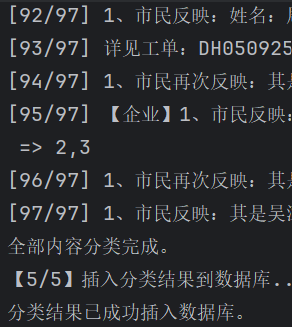
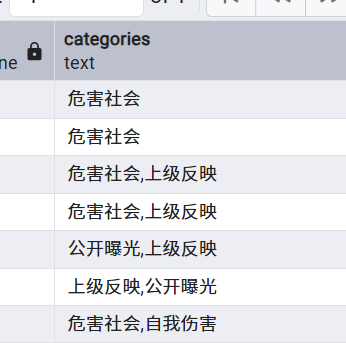
我将具体的”扬言“标识插入到数据库里面。
"""
classify.py
调用大模型对扬言内容进行分类,并支持多线程
"""

import requests
import time
from concurrent.futures import ThreadPoolExecutor, as_completed
from db import MAX_THREADS, MAX_RETRIES, BASE_DELAY, TIMEOUT

API_KEY = "                              "
API_URL = "https://ark.cn-beijing.volces.com/api/v3/chat/completions"
HEADERS = {
    "Authorization": f"Bearer {API_KEY}",
    "Content-Type": "application/json"
}

# -------------------- 单条分类函数 --------------------
def classify_yangyan_type(sentence):
    """调用大模型分类,严格映射到 5 类文字"""
    prompt = f"""
任务:根据以下扬言内容判断其具体类型。
要求:
1. 只输出类型文字,不允许数字或未知。
2. 一定一定要准确!!!看清楚要从打电话进来人的角度来看“扬言”类型
3. 类型只能是以下 5 类之一,可多选用逗号分隔:
   自我伤害, 危害社会, 上级反映, 法律途径, 公开曝光
4. 如果内容涉及多个类别,请全部列出,用逗号分隔。
5. 不要输出其他说明,不要换行。
6. 用数字代表类别,只输出数字

扬言内容:
{sentence}
"""
    payload = {
        "model": "deepseek-v3-250324",
        "messages": [{"role": "user", "content": prompt}],
        "temperature": 0.1,
        "max_tokens": 50
    }

    for attempt in range(1, MAX_RETRIES + 1):
        try:
            response = requests.post(API_URL, headers=HEADERS, json=payload, timeout=TIMEOUT)
            response.raise_for_status()
            result = response.json()
            if 'choices' in result and len(result['choices']) > 0:
                content = result['choices'][0]['message']['content'].strip()
                return content.replace("\n", ", ").strip()
            else:
                return sentence
        except requests.exceptions.HTTPError as e:
            if response.status_code == 429:
                delay = BASE_DELAY * attempt
                print(f"请求过多 429,等待 {delay} 秒重试(第 {attempt} 次)...")
                time.sleep(delay)
            else:
                print(f"HTTP 错误: {e}, 状态码: {response.status_code}")
                time.sleep(BASE_DELAY)
        except requests.exceptions.RequestException as e:
            print(f"网络请求错误: {e}, 第 {attempt} 次重试...")
            time.sleep(BASE_DELAY)
        except Exception as e:
            print(f"其他错误: {e}, 第 {attempt} 次重试...")
            time.sleep(BASE_DELAY)
    return sentence


# -------------------- 多线程分类函数 --------------------
def classify_all_types_with_progress(contents, progress_callback=None):
    """
    多线程分类,同时返回每条分类结果
    progress_callback: 可选回调函数,每处理一条记录就调用
                       回调函数参数: (processed_count, total_count, content, categories)
    """
    results = []
    total = len(contents)
    processed = 0

    def worker(record):
        categories = classify_yangyan_type(record[0])
        return (record, categories)

    with ThreadPoolExecutor(MAX_THREADS) as executor:
        future_to_record = {executor.submit(worker, r): r for r in contents}

        for future in as_completed(future_to_record):
            record, categories = future.result()
            results.append((record[3], record[0], record[1], record[2], categories))
            processed += 1
            if progress_callback:
                # 回调由 run_all.py 控制输出,而不是死板 print
                progress_callback(processed, total, record[0], categories)

    return results
#想要每次都进行内容的检索,因为新加入的还是需要重新跑一遍来确认5类的中具体类别
每一行遍历完之后打上标签进行记录存入数据库的表格里面。
def insert_type_results(results):
    """批量插入分类结果"""
    conn = conn_pool.getconn()
    try:
        cur = conn.cursor()
        cur.executemany(f'''
            INSERT INTO {NEW_TABLE} (id, content, community, call_time, categories)
            VALUES (%s, %s, %s, %s, %s);
        ''', results)
        conn.commit()
        cur.close()
    finally:
        conn_pool.putconn(conn)
4结果展示
5数据分析
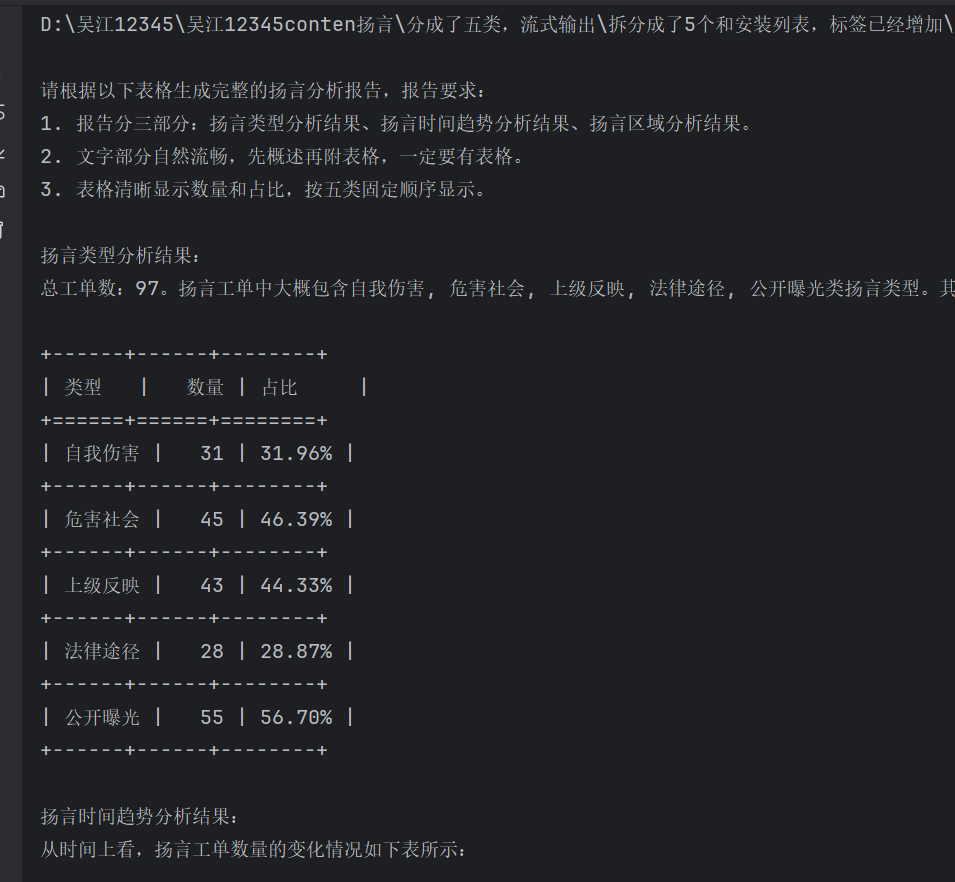
    prompt = f"""
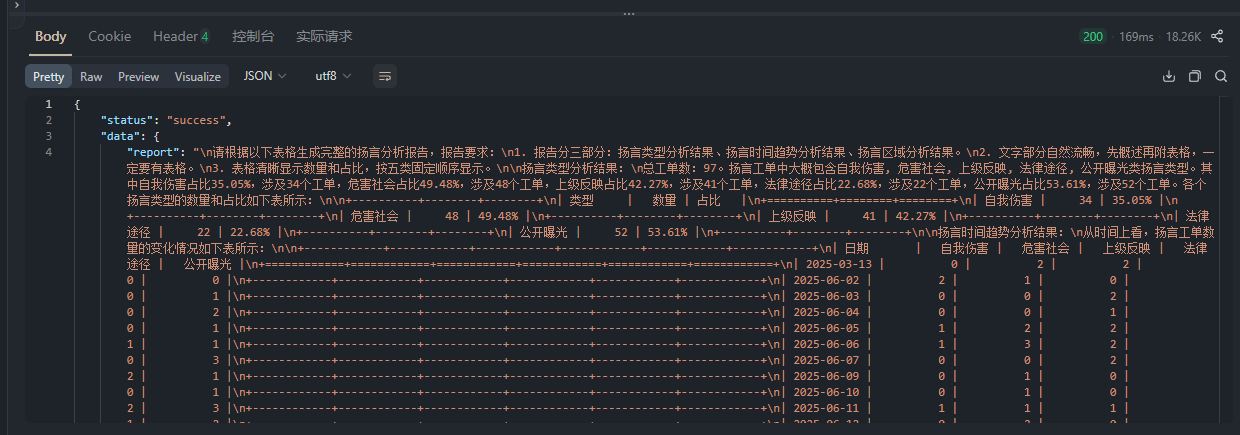
请根据以下表格生成完整的扬言分析报告,报告要求:
1. 报告分三部分:扬言类型分析结果、扬言时间趋势分析结果、扬言区域分析结果。
2. 文字部分自然流畅,先概述再附表格,一定要有表格。
3. 表格清晰显示数量和占比,按五类固定顺序显示。

扬言类型分析结果:
总工单数:{total_records}。扬言工单中大概包含{', '.join([t for t in CATEGORIES if t in type_counter])}类扬言类型。其中{type_summary}。各个扬言类型的数量和占比如下表所示:

{type_table_str}

扬言时间趋势分析结果:
从时间上看,扬言工单数量的变化情况如下表所示:

{date_table_str}

扬言区域分析结果:
各社区扬言工单数量及占比如下表所示:
6生成报告
7项目结构
classify.py
调用大模型对扬言内容进行分类,并支持多线程
import requests
import time
from concurrent.futures import ThreadPoolExecutor, as_completed
from db import MAX_THREADS, MAX_RETRIES, BASE_DELAY, TIMEOUT

API_KEY = "9b6b8bd0-      -4e53-ae63-91f89dbbddb8"
API_URL = "https://ark.cn-beijing.volces.com/api/v3/chat/completions"
HEADERS = {
    "Authorization": f"Bearer {API_KEY}",
    "Content-Type": "application/json"
}

# -------------------- 单条分类函数 --------------------
def classify_yangyan_type(sentence):
    """调用大模型分类,严格映射到 5 类文字"""
    prompt = f"""
任务:根据以下扬言内容判断其具体类型。
要求:
1. 只输出类型文字,不允许数字或未知。
2. 一定一定要准确!!!看清楚要从打电话进来人的角度来看“扬言”类型
3. 类型只能是以下 5 类之一,可多选用逗号分隔:
   自我伤害, 危害社会, 上级反映, 法律途径, 公开曝光
4. 如果内容涉及多个类别,请全部列出,用逗号分隔。
5. 不要输出其他说明,不要换行。


扬言内容:
{sentence}
"""
    payload = {
        "model": "deepseek-v3-250324",
        "messages": [{"role": "user", "content": prompt}],
        "temperature": 0.1,
        "max_tokens": 50
    }

    for attempt in range(1, MAX_RETRIES + 1):
        try:
            response = requests.post(API_URL, headers=HEADERS, json=payload, timeout=TIMEOUT)
            response.raise_for_status()
            result = response.json()
            if 'choices' in result and len(result['choices']) > 0:
                content = result['choices'][0]['message']['content'].strip()
                return content.replace("\n", ", ").strip()
            else:
                return sentence
        except requests.exceptions.HTTPError as e:
            if response.status_code == 429:
                delay = BASE_DELAY * attempt
                print(f"请求过多 429,等待 {delay} 秒重试(第 {attempt} 次)...")
                time.sleep(delay)
            else:
                print(f"HTTP 错误: {e}, 状态码: {response.status_code}")
                time.sleep(BASE_DELAY)
        except requests.exceptions.RequestException as e:
            print(f"网络请求错误: {e}, 第 {attempt} 次重试...")
            time.sleep(BASE_DELAY)
        except Exception as e:
            print(f"其他错误: {e}, 第 {attempt} 次重试...")
            time.sleep(BASE_DELAY)
    return sentence


# -------------------- 多线程分类函数 --------------------
def classify_all_types_with_progress(contents, progress_callback=None):
    """
    多线程分类,同时返回每条分类结果
    progress_callback: 可选回调函数,每处理一条记录就调用
                       回调函数参数: (processed_count, total_count, content, categories)
    """
    results = []
    total = len(contents)
    processed = 0

    def worker(record):
        categories = classify_yangyan_type(record[0])
        return (record, categories)

    with ThreadPoolExecutor(MAX_THREADS) as executor:
        future_to_record = {executor.submit(worker, r): r for r in contents}

        for future in as_completed(future_to_record):
            record, categories = future.result()
            results.append((record[3], record[0], record[1], record[2], categories))
            processed += 1
            if progress_callback:
                # 回调由 run_all.py 控制输出,而不是死板 print
                progress_callback(processed, total, record[0], categories)

    return results
#想要每次都进行内容的检索,因为新加入的还是需要重新跑一遍来确认5类的中具体类别
analyze.py
统计分析和生成文本报表,包括类型、时间趋势和社区分布
"""
analyze.py
统计分析和生成文本报表,包括类型、时间趋势和社区分布
"""
import psycopg2
from collections import Counter, defaultdict
from tabulate import tabulate

DB_HOST = "localhost"
DB_PORT = 5432
DB_NAME = "wujiang_system"
DB_USER = "postgres"
DB_PASSWORD = "12345"
DB_TABLE = "system.work_order_type"

CATEGORIES = ["自我伤害", "危害社会", "上级反映", "法律途径", "公开曝光"]

def fetch_records():
    conn = psycopg2.connect(
        host=DB_HOST,
        port=DB_PORT,
        database=DB_NAME,
        user=DB_USER,
        password=DB_PASSWORD
    )
    cur = conn.cursor()
    cur.execute(f"SELECT id, content, community, call_time, categories FROM {DB_TABLE};")
    rows = cur.fetchall()
    cur.close()
    conn.close()
    return rows

def analyze(records):
    type_counter = Counter()
    date_counter = Counter()
    community_counter = Counter()
    total_records = 0

    for _id, content, community, call_time, categories in records:
        total_records += 1
        if not categories:
            continue
        types = [x.strip() for x in categories.split(",")]
        for t in types:
            if t in CATEGORIES:
                type_counter[t] += 1
                if call_time:
                    date_str = str(call_time.date())
                    date_counter[(t, date_str)] += 1
                if community:
                    community_counter[(t, community)] += 1
    return type_counter, date_counter, community_counter, total_records

def build_tables(type_counter, date_counter, community_counter, total_records):
    type_table = []
    for t in CATEGORIES:
        count = type_counter.get(t, 0)
        pct = count / total_records * 100 if total_records else 0
        type_table.append([t, count, f"{pct:.2f}%"])
    type_table_str = tabulate(type_table, headers=["类型", "数量", "占比"], tablefmt="grid")

    date_summary = defaultdict(lambda: {cat: 0 for cat in CATEGORIES})
    for (t, date), count in date_counter.items():
        date_summary[date][t] = count
    date_table = []
    for date in sorted(date_summary.keys()):
        row = [date] + [date_summary[date][cat] for cat in CATEGORIES]
        date_table.append(row)
    date_table_str = tabulate(date_table, headers=["日期"] + CATEGORIES, tablefmt="grid")

    community_summary = defaultdict(lambda: {cat: 0 for cat in CATEGORIES})
    for (t, com), count in community_counter.items():
        community_summary[com][t] = count
    community_table = []
    for com in sorted(community_summary.keys()):
        row = [com] + [community_summary[com][cat] for cat in CATEGORIES]
        community_table.append(row)
    community_table_str = tabulate(community_table, headers=["社区"] + CATEGORIES, tablefmt="grid")

    return type_table_str, date_table_str, community_table_str

def build_prompt(type_table_str, date_table_str, community_table_str, type_counter, total_records):
    type_summary_list = []
    for t in CATEGORIES:
        if t in type_counter and type_counter[t] > 0:
            count = type_counter[t]
            pct = count / total_records * 100
            type_summary_list.append(f"{t}占比{pct:.2f}%,涉及{count}个工单")
    type_summary = ",".join(type_summary_list)

    prompt = f"""
请根据以下表格生成完整的扬言分析报告,报告要求:
1. 报告分三部分:扬言类型分析结果、扬言时间趋势分析结果、扬言区域分析结果。
2. 文字部分自然流畅,先概述再附表格,一定要有表格。
3. 表格清晰显示数量和占比,按五类固定顺序显示。

扬言类型分析结果:
总工单数:{total_records}。扬言工单中大概包含{', '.join([t for t in CATEGORIES if t in type_counter])}类扬言类型。其中{type_summary}。各个扬言类型的数量和占比如下表所示:

{type_table_str}

扬言时间趋势分析结果:
从时间上看,扬言工单数量的变化情况如下表所示:

{date_table_str}

扬言区域分析结果:
各社区扬言工单数量及占比如下表所示:

{community_table_str}
"""
    return prompt

# 添加测试代码
if __name__ == "__main__":
    records = fetch_records()
    print(f"获取到 {len(records)} 条记录")
    if records:
        type_counter, date_counter, community_counter, total = analyze(records)
        print(f"分析完成,总计 {total} 条记录")
db.py
数据库连接池和基础数据库操作
"""
db.py
数据库连接池和基础数据库操作
"""
# db.py

MAX_THREADS = 3
MAX_RETRIES = 5
BASE_DELAY = 5
TIMEOUT = 30

import psycopg2
from psycopg2.pool import ThreadedConnectionPool

DB_HOST = "localhost"
DB_PORT = 5432
DB_NAME = "wujiang_system"
DB_USER = "postgres"
DB_PASSWORD = "12345"

DB_TABLE = "system.work_order"
NEW_TABLE = "system.work_order_type"

conn_pool = None

def init_connection_pool():
    global conn_pool
    conn_pool = ThreadedConnectionPool(1, 10,
                                       host=DB_HOST,
                                       port=DB_PORT,
                                       database=DB_NAME,
                                       user=DB_USER,
                                       password=DB_PASSWORD)
    print("数据库连接池初始化完成")

def fetch_dangerous_contents():
    """提取 isDanger=true 的 content 及对应 community 和 call_time"""
    conn = conn_pool.getconn()
    records = []
    try:
        cur = conn.cursor()
        cur.execute(f'''
            SELECT "content", "community", "call_time","id"
            FROM {DB_TABLE}
            WHERE "isDanger" = true AND "content" IS NOT NULL;
        ''')
        records = cur.fetchall()
        cur.close()
    finally:
        conn_pool.putconn(conn)
    return records

def create_new_table():
    """创建存储类型的新表"""
    conn = conn_pool.getconn()
    try:
        cur = conn.cursor()
        cur.execute(f'''
            DROP TABLE IF EXISTS {NEW_TABLE};
            CREATE TABLE {NEW_TABLE} (
                id BIGINT,
                content TEXT,
                community TEXT,
                call_time TIMESTAMP,
                categories TEXT
            );
        ''')
        conn.commit()
        cur.close()
    finally:
        conn_pool.putconn(conn)

def insert_type_results(results):
    """批量插入分类结果"""
    conn = conn_pool.getconn()
    try:
        cur = conn.cursor()
        cur.executemany(f'''
            INSERT INTO {NEW_TABLE} (id, content, community, call_time, categories)
            VALUES (%s, %s, %s, %s, %s);
        ''', results)
        conn.commit()
        cur.close()
    finally:
        conn_pool.putconn(conn)
stream_output.py
支持大模型流式输出,直接返回给 FastAPI
"""
stream_output.py
支持大模型流式输出,直接返回给 FastAPI
"""
import requests
import json

API_KEY = "9b6b8bd0-     -4e53-ae63-91f89dbbddb8"
API_URL = "https://ark.cn-beijing.volces.com/api/v3/chat/completions"
HEADERS = {
    "Authorization": f"Bearer {API_KEY}",
    "Content-Type": "application/json"
}

def stream_call_model(prompt):
    data = {
        "model": "deepseek-v3-250324",
        "messages": [{"role": "user", "content": prompt}],
        "temperature": 0.7,
        "stream": True
    }

    try:
        response = requests.post(API_URL, headers=HEADERS, json=data, stream=True)
        response.raise_for_status()

        for line in response.iter_lines():
            if line:
                line = line.decode("utf-8").strip()
                if line.startswith("data: "):
                    payload = line[len("data: "):]
                    if payload == "[DONE]":
                        break
                    try:
                        event = json.loads(payload)
                        delta = event["choices"][0]["delta"]
                        if "content" in delta:
                            yield delta["content"]
                    except Exception as e:
                        print(f"解析出错: {e}")
    except Exception as e:
        print(f"请求失败: {e}")
        yield f"请求失败: {str(e)}"
run_all.py
完整流程脚本:
1. 初始化数据库连接池
2. 创建新表
3. 提取危险内容
4. 调用大模型分类
5. 插入分类结果
from db import init_connection_pool, create_new_table, fetch_dangerous_contents, insert_type_results
from classify import classify_all_types_with_progress

def run(progress_callback=None):
    # -------------------- 1. 初始化数据库连接池 --------------------
    if progress_callback:
        progress_callback("【1/5】初始化数据库连接池...")
    init_connection_pool()

    # -------------------- 2. 创建新表 --------------------
    if progress_callback:
        progress_callback("【2/5】创建新表...")
    create_new_table()
    if progress_callback:
        progress_callback("新表已创建完成。")

    # -------------------- 3. 提取危险内容 --------------------
    if progress_callback:
        progress_callback("【3/5】提取 isDanger=True 的内容...")
    records = fetch_dangerous_contents()
    if progress_callback:
        progress_callback(f"共提取到 {len(records)} 条扬言内容。")
    if not records:
        if progress_callback:
            progress_callback("没有发现任何危险内容,流程结束。")
        return []

    # -------------------- 4. 调用大模型分类 --------------------
    if progress_callback:
        progress_callback("【4/5】开始分类内容...")

    def classification_progress(processed, total, content, categories):
        if progress_callback:
            progress_callback(f"[{processed}/{total}] {content} => {categories}")

    results = classify_all_types_with_progress(records, progress_callback=classification_progress)
    if progress_callback:
        progress_callback("全部内容分类完成。")

    # -------------------- 5. 插入分类结果 --------------------
    if progress_callback:
        progress_callback("【5/5】插入分类结果到数据库...")
    insert_type_results(results)
    if progress_callback:
        progress_callback("分类结果已成功插入数据库。")

    return results


if __name__ == "__main__":
    run(progress_callback=print)
使用apifox进行get请求


中国智能体开发者社区,聚焦智能体与大模型开发,提供前沿资讯、实用工具链、开源项目及行业案例。通过技术沙龙、开发者大赛等活动,促进经验交流与协作,助力开发者快速构建创新智能应用。
更多推荐

 5
5 0
0- 0


 已为社区贡献6条内容

所有评论(0)